






MP demands a hospital readiness plan, answers on nursing shortages and overseas treatment costs, while questioning why private bridge works can proceed but his school repair offer faced restrictions.
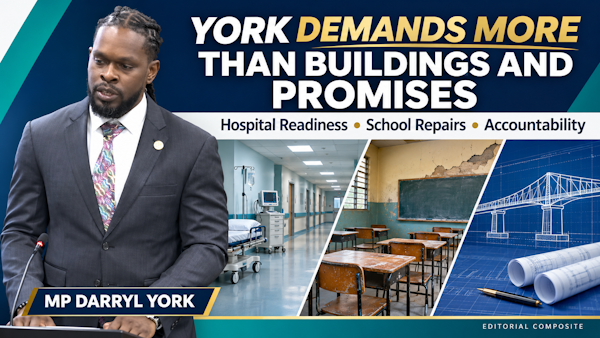 PHILIPSBURG:--- MP Darryl York has warned that opening St. Maarten’s new hospital must be backed by the staff, equipment, financing and services needed to treat patients, arguing that a completed building alone would not constitute a functioning healthcare system.
Continuing his contribution to the 2027 budget debate, York demanded a comprehensive operational readiness assessment from VSA Minister Claret Connor.
“The worst thing that could happen,” he said, would be a grand opening with “an empty shell.”
York also challenged government over school repairs, public-private partnerships, road maintenance and unresolved safety concerns on Cole Bay Hill.
His criticism centered on the gap between government’s presentations and the practical arrangements needed to deliver results.
“The people need solutions,” he said. “The people would like to know what is happening and how it’s going to happen and when it’s going to happen.”
What will the new hospital actually provide on opening day?
York asked Connor to provide Parliament with an assessment covering staffing, medical equipment, specialist services, information systems, licensing, financing and transition planning.
He wanted to know which areas were sufficiently prepared and which remained outstanding.
He also requested a departmental implementation schedule distinguishing services that would operate from opening day from those planned for later phases.
York asked which services currently envisioned for the hospital would not be available initially.
His questions went beyond a construction timetable. He sought confirmation that government and St. Maarten Medical Center had established a formal transition and commissioning plan with measurable milestones and contingency arrangements.
The concern was whether the move into the new facility would translate into expanded, reliable care rather than an opening ceremony followed by unresolved operational limitations.
Contractor payment concerns require clarification
York asked Connor to address reports he said had circulated during the former minister’s tenure that the hospital contractor was seeking substantial additional funds.
He requested confirmation of whether those reports were accurate, whether an agreement or compromise had been reached and how much additional money, if any, would be paid.
He did not establish that an additional payment had been approved. His question sought the financial position and any agreement reached with the contractor.
Which overseas treatments could be brought home?
York demanded an account of the medical services currently requiring patients to travel abroad that could eventually be delivered at the new hospital.
For each, he requested an anticipated introduction date and the number of patients expected to benefit annually.
He also asked for the annual cost of overseas referrals, including treatment, transportation and accommodation.
York wanted to know whether the relevant institutions had projected how much of that expenditure could be retained locally and what savings might be achieved during the first three years after opening.
He proposed examining the five most expensive categories of overseas referrals to determine whether providing those services locally would be medically feasible and financially advantageous.
Those were requests for analysis, rather than an assertion that every expensive overseas service could safely or economically be transferred to St. Maarten.
Nursing shortages could undermine readiness
York questioned how the hospital would secure the personnel needed to operate a larger facility.
He asked how many nurses SMMC currently employed, how many additional nurses the new hospital would require and how those positions would be filled.
He also highlighted a difficulty in developing existing staff: when a hospital is already understaffed, releasing nurses for further education can be difficult because they are needed on the floor.
York asked what recruitment and training strategy would address that problem.
He requested the number and types of doctors and specialists required, the status of recruitment and whether St. Maarten professionals working abroad had been approached.
He asked how many had been contacted and requested the names confidentially.
York also sought information on nurses’ cost-of-living adjustments, including whether they had received adjustments for 2025 and 2026 and how consistently these had been granted over the preceding decade.
What will the hospital cost to operate?
York requested a comparison between the projected annual operating budget of the new hospital and that of the current facility.
He asked for additional expenditure to be broken down across personnel, utilities, equipment maintenance, technology and medical supplies.
He also questioned whether a strategy existed to position the hospital as a regional healthcare provider.
That strategy, he argued, would need to identify services that were both clinically and commercially viable for patients from neighboring islands.
His questions required government to explain how expansion of services, recruitment and financing would fit together.
Overseas care must be assessed through patients’ experiences
York separately pressed Connor about the quality of services provided to patients referred abroad, particularly to Cali, Colombia.
He criticized what he described as an earlier ministerial visit that had produced a favorable account without including discussions with patients or their accompanying persons.
According to York, the former minister had acknowledged not speaking with those groups.
York argued that information from the institutions delivering or coordinating services was insufficient on its own to establish the quality of patients’ experiences.
He referred to a case previously brought to Connor’s attention and requested a confidential update rather than disclosing the person’s medical details in Parliament.
His remarks did not establish a clinical finding against a particular overseas provider. They demanded a broader approach to monitoring the services for which substantial public or social insurance resources were being spent.
Why can a developer repair bridges while an MP’s school offer faces restrictions?
York’s challenge to the government’s approach to outside assistance focused on a comparison between a bridge repair partnership in Sucker Garden and his proposal to help repair his former public primary school.
He said he supported public-private partnerships but wanted consistent, transparent rules.
York described an arrangement under which a developer would finance bridge and canal works and select the contractor.
He contrasted that with restrictions he said were placed on his offer to repair cracks, address roofing and bathroom problems and paint the school.
According to York, concerns about structural work and government liability had prevented parts of his proposal from proceeding.
He asked why liability concerns restricted his proposed assistance while privately financed work on other public infrastructure could advance.
“Make it make sense,” he said.
His comparison raised a question about the criteria applied to different arrangements. It did not establish that school repairs and bridge works involved identical technical, insurance or approval requirements.
York sought an explanation of those distinctions and a workable route for assistance.
School problems should be repaired, not endlessly assessed
York said some bathroom problems at the school dated back to his own attendance around 1999–2001.
He expressly acknowledged that those longstanding conditions could not be attributed entirely to the current minister.
His frustration concerned the continued presence of the problems and what he described as obstacles facing those offering help.
York said he had encouraged other MPs to adopt schools and argued that Parliament’s members could collectively assist the public primary school system.
He challenged the duration of assessments and the description of work as emergency repairs when the problems continued for months.
Responding to an earlier suggestion to use stronger barriers around an unsafe school area, York said the priority should be completing the repair.
“Don’t put a green mesh. Fix it,” he said.
His broader demand was for the government to explain how it would obtain and deploy resources, rather than repeatedly stating that more money was needed.
Education funding and culture also draw criticism
York criticized ECYS Minister Melissa Gumbs’ presentation, saying parents and teachers needed concrete measures to look forward to.
He questioned what the Council of Ministers was doing to address the funding shortfall the ministry identified, even if only part of the requested amount could initially be secured.
He also revisited an earlier proposal to increase cultural funding through an amendment that, according to his account, would have drawn from travel expenditure.
York disputed the minister’s understanding of the amendment and alleged that its source had not been properly considered.
Those were his criticisms of the earlier exchange; his statement did not include the amendment or the minister’s full response.
During an interruption, MP Egbert Jurendy Doran also questioned how the announced budget surplus related to ECYS’s reported 11.8 million funding gap and pressure on VSA.
The exchange called for a clearer explanation of spending priorities. An overall budget surplus and unmet ministry funding requests measure different things and do not, by themselves, establish that the accounts contradict each other.
Roads: “We get what we pay for”
York also responded to criticism of roadwork quality, drawing on his experience working for the company under discussion.
He openly disclosed that connection.
He argued the result depended on the work the government specified and paid for, including whether a project involved limited resurfacing or more extensive treatment.
“We get what we pay for,” he said.
York disputed a simple comparison between the airport runway and public roads, saying the specifications and spending differed.
He recalled an airport parking-area resurfacing example that, in his account, had experienced similar problems when a limited approach was used.
His comments defended examining procurement specifications and the scope of work before attributing every failure to the contractor.
Cole Bay Hill: What changed after the accident?
York asked VROMI and Justice for updates on road markings and camera coverage at a bend on Cole Bay Hill following a serious accident.
He said the markings and lack of cameras affected how the incident was handled and questioned why the issues remained unresolved months later.
His description of those consequences was his account; the supplied statement did not include the relevant legal findings.
York nevertheless demanded a timetable to correct the markings and address camera coverage.
He also requested an update on VROMI’s discussions concerning Mullet Bay, asking what the talks had produced.
Across healthcare, education and infrastructure, York’s continued challenge asked the government to show the work behind its announcements: the staffing, the operating budgets, the approvals, the procurement choices and the dates on which residents would see a difference.