






DP leader demands answers on capital projects, healthcare debt and government-owned companies, urging Cabinet to confront the CFT’s advice on the 2027 budget itself.
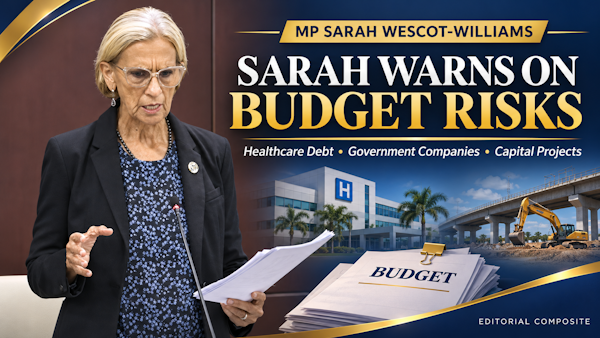 PHILIPSBURG:--- Democratic Party leader MP Sarah Wescot-Williams has warned that St. Maarten cannot continue preparing budgets without fundamentally addressing healthcare liabilities, financially troubled government-owned companies and the country’s limited cash position.
During the 2027 budget debate, Wescot-Williams urged ministers to move beyond the controversy surrounding the CFT’s assessment of the adopted 2026 budget and explain how they intended to address the supervisory body’s concerns about the draft now before Parliament.
“What about the CFT’s advice on the budget, which is before us?” she asked.
Her intervention challenged the entire Council of Ministers to produce a collective financial strategy, rather than leave successive Finance Ministers defending budgets constrained by the same unresolved problems.
“If you don’t take action now, everything is going to run out on you,” she warned.
The warning concerns 2027, too
Wescot-Williams distinguished between the CFT’s advice on the draft 2026 budget and its subsequent assessment after parliamentary adoption.
She argued that the concerns about healthcare funds and government-owned companies were longstanding, recalling supervisory warnings dating back to approximately 2015.
But her central concern was the advice on the draft 2027 budget.
Reading from that advice during her contribution, she said several budget components required amendment and that considerable risks involving healthcare funds, government entities and liquidity needed to be incorporated.
She also cited the CFT’s acknowledgment that government recognized the risks and had begun addressing them.
According to the passage she read, the supervisory body wanted continued engagement to improve public finances and avoid advising the Kingdom Council of Ministers to issue a new formal instruction.
Wescot-Williams presented that as a warning requiring action. She did not say a new instruction had already been issued.
Her demand was for the government to explain how it would prevent the risks identified in the advice from continuing to undermine its financial plans.
Where do the capital projects come from?
Wescot-Williams asked Finance Minister Marinka Gumbs to explain how projects entered the capital budget.
Who submitted them? What requirements did they have to meet? And how did government establish that they were ready to proceed?
She said an earlier request to identify “shovel-ready” projects had not produced an answer.
That distinction mattered, she argued, because projects expected to receive financing late in 2026 needed to be sufficiently prepared to allow execution within the remaining time.
“I want the government, I want the ministers to explain how we come to capital projects in a budget,” she said.
Wescot-Williams suggested government produce a clear public explanation of the budget preparation process, similar to Parliament’s educational videos.
Her concern was that including a project in a budget did not, by itself, demonstrate that its preparation, financing and implementation requirements had been met.
“We cannot continue like this,” she said.
Healthcare debt remains a structural threat
Wescot-Williams questioned whether general health insurance would be enough to resolve the country’s financial and healthcare pressures.
She acknowledged that reforms and additional visitor revenue could help but challenged the government to explain the scale of the problem they would actually address.
“They’re going to fill a hole, but how much of a hole?” she asked.
She referred to the repeated appearance of SZV-related debt and healthcare risks in budget discussions.
Her argument was that liabilities could not remain a recurring warning without a broader decision about the system's sustainability.
Wescot-Williams asked whether St. Maarten could continue with its current healthcare model or should explore closer alignment with a larger healthcare institution or organization.
She framed the issue around the care residents could realistically receive as costs increased.
Her remarks were a call for strategic assessment, not an announcement that the government had decided to replace the existing system.
Government companies require solutions
Wescot-Williams said the CFT referred to PSS, Telem and GEBE as insolvent entities and was seeking solutions.
She presented that characterization through her account of the supervisory advice.
She challenged the government to explain how it would address the financial risks of its companies and reflect them in the country’s wider financial picture.
She also requested the agreement involving government and GEBE for the generators, which she understood was being signed that evening.
Whether the arrangement was a purchase, lease-purchase or another form of agreement, Parliament should receive it, she said.
Her request linked a major investment decision to the need to scrutinize the utility’s obligations and the government’s financial exposure.
Recovery funding cannot carry the country indefinitely
Wescot-Williams placed the debate within the longer history of St. Maarten’s financial pressures.
She recalled that problems involving tourism growth, immigration, crime and traffic were already prominent before Hurricane Irma.
The hurricane was followed by recovery funding, and the COVID period brought additional lending and the country package.
She argued that successive governments had continued operating with the support of those arrangements without resolving enough of the underlying problems.
Her criticism focused on the danger of letting temporary or exceptional support substitute for sustainable revenue and spending decisions.
Cabinet must return with a collective position
Wescot-Williams asked when a 2027 budget amendment would address measures she identified as absent from the draft, including gambling taxation, formal tax-law revisions and withholding relating to political officeholders.
She also requested a clearer assessment of government’s liquidity.
Parliament’s duty to scrutinize that position applied regardless of political affiliation, she said.
“Opposition? Coalition? In between? Both sides? Whichever one. We got a duty in here.”
Wescot-Williams argued that unless fundamental issues changed, future Finance Ministers would encounter the same pressures and public backlash.
She urged the Council of Ministers to return together with a realistic account of its direction for the country.
As the administration approached the midpoint of its term, she said, the government needed to take stock of both its starting position and the decisions still required.
“I would really like the Council of Ministers to come back and together give us something,” she said — something reflecting what ministers collectively envisioned for St. Maarten’s future.