






DP leader seeks a public-private partnership policy, questions whether waste contracts allow investment recovery and presses ministers for specific answers instead of broad assurances.
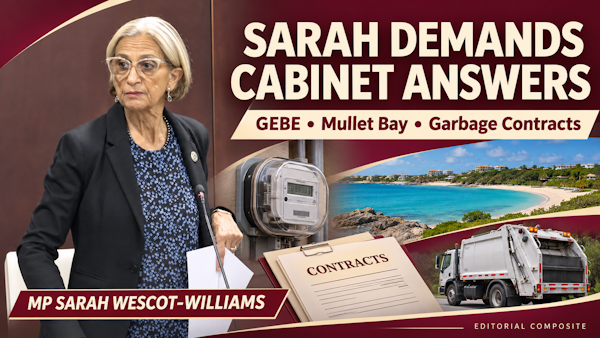 PHILIPSBURG:--- MP Sarah Wescot-Williams has demanded a coordinated government response to unresolved questions involving GEBE, Mullet Bay, garbage collection contracts and public-private partnerships, telling ministers that broad explanations are not enough.
During the 2027 budget debate, the Democratic Party leader said she wanted to direct her questions to government collectively, rather than allow issues spanning several portfolios to remain divided among individual ministers.
“I want to direct them to the government,” she said. “And I expect answers from the government.”
Her contribution combined requests for documents with questions about how policy decisions were being implemented.
GEBE recommendations: Answer each question
Wescot-Williams requested detailed responses to her letter to Prime Minister Dr. Luc Mercelina, TEATT Minister Grisha Heyliger-Marten, and VROMI Minister Patrice Gumbs Jr. on implementing the RAC/BTP recommendations.
She wanted each responsible minister to explain which actions could be taken.
“Can you do A, can you do B, can you do C, can you do D,” she said, illustrating the level of specificity she expected.
She also requested the agreement between the government and GEBE for the generators, which she understood was being signed that evening.
Parliament needed to know the nature of the arrangement, she argued, rather than rely solely on announcements about the investment.
Are three-year garbage contracts financially realistic?
Wescot-Williams questioned whether a three-year contract term made sense for garbage collection services requiring substantial investment.
Her concern was not which company received a contract, she said, but whether the duration allowed an operator to recover the expenditure necessary to provide the service.
She questioned whether some investments could be recovered even within five years.
Wescot-Williams said she had previously raised the issue with Gumbs and understood that a report had been received or was expected that supported reconsidering the approach.
She asked whether its findings could influence the process currently underway.
Her contribution did not include a financial model establishing an appropriate term. It challenged the minister to explain how contract duration aligned with investment requirements and the available advice.
Public-private partnerships need a policy
Wescot-Williams asked VROMI to provide its public-private partnership policy.
She noted that such partnerships formed part of the governing accord but argued that an agreed political objective still needed an underlying framework.
“Do you have a public-private partnership policy?” she asked. “And if so, please share it.”
Her request sought the rules by which government would assess, approve and manage the arrangements.
It came amid wider parliamentary scrutiny of privately financed public infrastructure projects.
Wescot-Williams did not suggest rejecting every partnership. She demanded the policy needed to explain how they were being pursued.
Mullet Bay: What has government actually agreed?
Wescot-Williams sought a fuller account of the Mullet Bay process.
She questioned the relationship between litigation involving Sun Resorts, an appeal, and the parties she understood were expected to cooperate with government on the matter.
She also revisited an earlier answer stating that Sun Resorts had submitted a draft zoning plan.
According to her account, the response referred to Mullet Pond as a buffer, public beach access and the golf course.
But she said her questions about the road and the government’s position concerning the property had not been directly answered.
She wanted ministers to address those points rather than repeat the general conditions surrounding the zoning proposal.
Her statement did not include the court judgment or the full agreements. Her intervention sought clarification of the policy and legal position.
Road Fund explanations have left her confused, too
Wescot-Williams joined other MPs in demanding clarity on the Road Fund.
“I too kind of lost it in the articles,” she said.
She requested a clear explanation rather than expecting Parliament to reconcile different public statements.
Wescot-Williams also asked how zoning decisions would be handled while the country awaited a broader zoning framework.
She sought confirmation of whether an agreement with VNG International was in place.
Her questions reflected broader concern about the rules guiding current decisions while longer-term plans and staffing arrangements were still being developed.
Vehicle registration and wreck removal need follow-through
Wescot-Williams asked whether government considered vehicle registration a sufficient priority to act on it across traffic management, crime and abandoned vehicles.
If it was a priority, she wanted to know what remained necessary to get the work done.
She welcomed the vehicle-wreck collection tender but asked whether the program could now be executed.
Referring to Orange Grove Road, she described one abandoned vehicle being stripped, removed, and then replaced by another undergoing the same treatment.
“We can’t continue like this,” she said.
She also requested progress on administrative enforcement, linking the issue to the government’s ability to act on persistent problems in public spaces.
Community fund requires more than a promise of discussions
Wescot-Williams asked VSA for more detail on the community-driven fund proposed through an earlier parliamentary motion.
She said the response referred to discussions with SMDF and the development of a strategic plan.
She wanted concrete information about how the proposal would be worked out.
Wescot-Williams described the initiative as a reduced version of her earlier smart-city and smart-district ambitions.
She thanked VROMI for supporting the motion but emphasized that the revised proposal still needed implementation details.
Healthcare referrals and senior care need a clearer framework
Wescot-Williams asked VSA whether St. Maarten had a strategic agreement with Colombia concerning medical referrals.
Referring to an arrangement she said Curaçao had entered into, she asked whether a similar approach would suit St. Maarten.
She also sought clarity on the Social Registry Program and senior care.
On professional regulation, she asked whether government still intended to pursue BIG legislation or would limit its approach to the Healthcare Professionals Registration framework discussed in the debate.
Those questions sought the ministry’s policy direction rather than assuming that the different arrangements were equivalent.
Regional cooperation: Give a yes-or-no answer
Wescot-Williams said the replies had not made the government’s position on regional cooperation sufficiently clear.
She referred to an internal note mentioned in the answers but asked whether government intended to continue pursuing associate membership with organizations including CARICOM.
“Yes or no?” she asked.
She also welcomed Heyliger-Marten’s engagement with charter operators over Anguilla’s policies and requested similar attention to French-side rules affecting charters from Dutch St. Maarten.
On the Simpson Bay Lagoon, she asked who managed it, how the arrangement worked and what income it generated.
She also questioned whether fees were charged for the Causeway Bridge and, if so, who collected them.
Cannabis confidentiality advice must be shared
Wescot-Williams requested the status of legal advice concerning confidentiality in the cannabis matter.
If Parliament had received the advice, she asked whether It could obtain it.
The request sought clarity on the legal position governing access to information, rather than relying on a general reference to confidentiality.
Legislative support and classroom devices also draw questions
Wescot-Williams asked Mercelina how the proposed legislative pool involving BZK would operate.
She wanted clarity on recruitment, funding and the placement of lawyers within St. Maarten’s administration.
She also requested an ECYS update on the discussion about devices in classrooms.
Rather than automatically copying restrictions adopted elsewhere, she supported examining how devices could be used more effectively for education and asked what follow-up had occurred.
Lewis intervenes, but Wescot-Williams clarifies the timing
MP Lyndon Lewis interrupted to question why the President of Parliament appeared to be seeking so many answers from coalition ministers.
Wescot-Williams acknowledged that ministers did not always respond promptly to MPs.
But she clarified that the letters she had just listed were recent and that she had emailed them directly because official transmission could take time.
That distinction prevented her requests from being read as proof that every letter mentioned had been ignored for an extended period.
Her demand remained for responses precise enough to permit follow-up.
If an idea could not be pursued, she argued, ministers should say so. If it could be examined, they should explain the next step and give a timeframe.
As government approached the midpoint of its term, Wescot-Williams urged Cabinet to review the governing accord and identify which commitments had been completed, which were underway and which remained ahead.