






Minister outlines collection from short-term rentals and overseas owners as MPs demand clarity on low-income impacts, project financing and the promise of a 2027 “year of execution.”
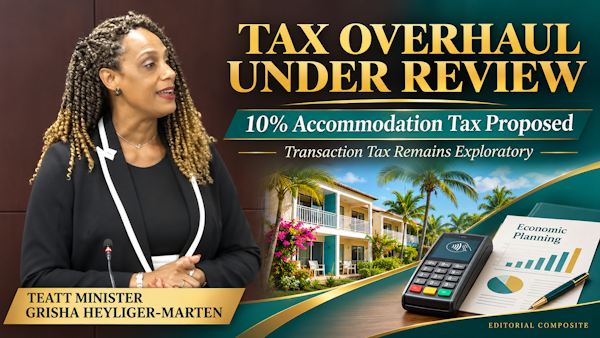 PHILIPSBURG:--- TEATT Minister Grisha Heyliger-Marten confirmed that a draft amendment proposes raising the accommodation tax from 5% to 10% and extending it to comparable tourist accommodation, including villas, apartments and short-term vacation rentals.
However, she made clear that the separate financial transaction tax remained under exploration, with no adopted rate or implementation date.
During the November 6 continuation of the 2027 draft budget debate, Heyliger-Marten outlined plans to strengthen collection from overseas property owners, allow agreements with booking platforms and modernize the country’s economic institutions.
Her declaration that 2027 would be a “year of execution” met pointed questions from MPs about financing, legislative capacity and whether the proposed transaction tax would leave minimum-wage households worse off.
Accommodation-tax increase included in draft
Responding to MP Sjamira Roseburg, Heyliger-Marten said the increase from 5% to 10% was already included in the draft accommodation-tax amendment under review at Legal Affairs.
The proposed framework would extend coverage to hotels, villas, apartments and short-term vacation rentals, with the intention that comparable accommodation contributes on a fairer basis.
She also described modernizing rental definitions, changes to timeshare taxation, stronger collection arrangements, allocating revenue to tourism marketing, and a phased increase in the accommodation tax.
The minister said Finance’s position on the proposed rate still needed confirmation as the ministries worked through the amendments and collection arrangements.
The 10% rate was therefore a proposal, not an approved tax announced for immediate collection.
Roseburg asked whether additional revenue could support cleaner communities or electricity relief. Heyliger-Marten said those would require separate budget decisions with Finance.
Overseas owners and booking platforms included
Answering MP Sarah Wescot-Williams, the minister said the proposed legislation would apply regardless of whether owners lived in St. Maarten or abroad.
Paid short-term rentals arranged directly or through platforms such as Airbnb and Booking.com would fall within the modernized framework.
A proposed provision would allow the Finance Minister to enter into collection agreements with local and international entities, including booking platforms, rental companies and accommodation intermediaries.
Under those arrangements, participating entities would collect the applicable tax from guests and remit it to the government.
The draft also contemplated stronger monitoring, including technology to identify properties advertised online.
Heyliger-Marten said the ministry was additionally examining whether nonresidents should be required to obtain a CRIB number before purchasing real estate. She did not announce that it had adopted such a requirement.
Rental tax does not resolve zoning concerns
MP Dimar Labega questioned the expansion of vacation rentals into residential neighborhoods and its effect on long-term housing availability.
He asked whether the legislation would include zoning provisions or limits to preserve residential accommodation.
Heyliger-Marten said the current draft addressed taxation rather than spatial planning and did not provide separate rental zones.
She suggested that stronger registration and collection arrangements could help establish where rentals operated, creating a basis for later zoning discussions.
Her response did not announce restrictions on short-term rentals in residential areas or a timetable for a separate zoning measure.
No proposed 5% to 10% transaction-tax rate
On the financial transaction tax, Heyliger-Marten rejected the suggestion that government had proposed a rate between 5% and 10%.
She said the 5% figure previously presented was illustrative.
The work so far relied on Central Bank payment data, government revenue figures and scenarios examining whether a transaction-based measure could replace or reduce existing taxes.
However, she acknowledged that billions moving through the banking system could not automatically be treated as a taxable base.
The assessment would need to determine which transactions could be taxed, which should be exempt, and the consequences for households, businesses, inflation and government revenue.
“This has not yet completed a feasibility study,” she said, distinguishing preliminary research from a final assessment.
Minimum-wage impact remains unanswered in numbers
MP Darryl York clarified that his concern was not about any particular rate.
He wanted to know how a transaction tax would affect the purchasing power of people earning minimum wage or less, especially those already paying little or no wage tax.
Heyliger-Marten said the social and economic effects would form part of the assessment.
She suggested that businesses retaining more capital might hire more employees or increase salaries, but did not present a quantified distributional analysis or establish that those outcomes would occur.
Her stated objective was that residents should be better off, not worse off, under any eventual reform.
For low-income households, the practical question therefore remained open: would savings from reduced existing taxes exceed any additional costs passed through prices or financial transactions?
Finance coordination defended; task-force formalities continue
Heyliger-Marten credited MP Ludmila de Weever with exploring the concept during her tenure as TEATT Minister in 2020.
“Good policies should not have an expiration date simply because a minister leaves the office,” she said.
She reported that TEATT had presented its exploratory findings to Finance and that the Finance Minister had requested Central Bank advice.
She described a joint technical task force, but later clarified that its formal arrangements were being finalized following legal advice, with completion hoped for before year-end.
MP Ardwell Irion questioned whether Finance was equally committed, saying he had not received that impression from the Finance Minister’s presentations.
Heyliger-Marten replied that Finance was on board for the preliminary phase and that TEATT was leading the exploratory work under the governing program.
“I’m not saying that it’s going to happen,” she said. “We’re simply exploring it.”
She also agreed to compile available reports requested by Irion, who referred to earlier work involving BDO, the IMF, the Central Bank and Fiscal Affairs. The exchange did not establish the conclusions of any of the documents he mentioned.
Wescot-Williams and York pressed for clarity on how the proposal related to tax reform already underway. Heyliger-Marten said Finance’s participation should allow the processes to move together, but did not present a consolidated roadmap.
Airport-port cooperation and possible shared services
Responding to MP Viren Kotai, Heyliger-Marten supported examining whether closer coordination between the airport and port could reduce costs and improve investment decisions.
She said an Ernst & Young assessment of the port group’s governance structure could help determine the next steps, including whether further financial and legal due diligence was warranted.
She also proposed examining shared services or possible combinations involving other government-owned companies, including GEBE and TeleM.
Examples included fiber infrastructure, billing and administration.
She acknowledged that any merger would require proper financial, legal and operational assessment. No merger or unified authority was announced as approved.
“Year of execution” challenged on financing
Heyliger-Marten said much of the previous two years had involved policy development, legislation, stakeholder engagement and project preparation.
“I see 2027 as our year of execution,” she said.
MPs questioned how that promise could be delivered if the capital financing underpinning projects remained uncertain.
MP Lyndon Lewis asked where the money would come from. Irion cautioned that government could not operate on “hopes and dreams” and requested the alternative financing plan.
Heyliger-Marten said the ministry was working with strategic partners and had a plan B for many projects if capital financing did not proceed.
She subsequently acknowledged that alternative arrangements could help advance some projects, not all.
She did not identify committed partner funding, contractual arrangements or a complete project-by-project financing schedule.
Met Office, square and Philipsburg projects at different stages
The minister identified the Met Office project as a critical capital investment with a development plan prepared in collaboration with NRPB.
Development plans for Clem Labega Square were being procured, while strategic-partner discussions were underway for Philipsburg beautification.
She supported incorporating local murals into the broader plans and said additional alleys offered opportunities for that work.
On the removal of the umbrella attraction, she said it had not been a TEATT installation. Christmas decorations would begin soon, with further possibilities to be discussed after the season.
She also confirmed that local marketing firms and influencers would be engaged once policies governing their participation and the ambassador program were developed.
Project Walk targeted for mid-December
Heyliger-Marten disputed the claim that cruise ferry passengers were being dropped exclusively at Walter Plantz Square.
According to information she obtained from operators, one-ship days involved service to Bobby’s Marina and Captain Hodge Wharf, with three designated drop-off points served when two or more ships were in port.
She said businesses near Walter Plantz Square had complained about insufficient passenger traffic.
The minister also described a new pedestrian-access initiative, Project Walk, expected to open around mid-December 2026.
It was intended to improve movement from the cruise-port area toward Philipsburg and address congestion and unauthorized solicitation near the port entrance.
She discussed changes in cruise shopping-promotion arrangements that she believed could redirect more passengers toward town, but did not present independently measured results from those changes.
Licensing progress, but performance targets unfinished
Heyliger-Marten reported that the licensing department was processing applications received in 2026 within the same year.
Only a handful from 2025 remained, primarily awaiting additional information from applicants, she said.
Although the question requested an updated backlog figure, her reference to more than 300 applications did not provide a clearly defined current outstanding total.
She maintained the objective of reducing processing times from months to weeks.
Numerical inspection targets for 2027 had also not been finalized. Performance indicators were being developed around inspection coverage, compliance, complaint handling and corrective action.
The ministry’s function book was with P&O for changes, with an initial draft anticipated in 2027 but no firm completion date.
Tourism figures must be validated first
The minister declined to provide final numerical tourism targets before a validated picture of 2026 performance was available.
Targets had to reflect arrivals, cruise capacity, hotel occupancy and spending patterns, she argued.
She clarified that the 5.1 million-guilder tourism-development allocation covered a combined program, not each individual campaign.
She said the online entry system shared electronic arrival information with Statistics and used it for tourism insights and dashboards.
She also attributed some reporting delays at the airport to its management transition and said passenger projections indicated the airport could surpass one million passengers during the year.
Cannabis legislation expected in 2027, without projected revenue
Heyliger-Marten said the cannabis draft was being revised following initial Legal Affairs advice and would continue through the advisory process.
She expected to submit it to Parliament in 2027.
However, she defended excluding cannabis revenue from the budget because the legislation and regulatory framework had not been approved.
“There is a difference between identifying potential revenue sources and actually being in the position to collect that revenue,” she said.
She also maintained the confidentiality of the submitted cannabis agreement despite MPs questioning why details had appeared publicly.
Legislative priorities and investment vehicles
Asked by Roseburg to identify her top three legislative priorities, Heyliger-Marten named the agriculture, livestock and fisheries agency, competition and consumer protection legislation, and the Gambling Authority law.
Her broader agenda included tourism governance, cannabis, pricing, telecommunications number portability, business licensing, independent statistics, public transportation and investment promotion.
She expected some legislation to be ready from the second quarter of 2027 onward.
The minister also described restructuring EDC through financial and governance cleanup, a supervisory board and management recruitment.
Her longer-term vision connected an investment promotion agency attracting investment, EDC executing projects, and a potential national development bank facilitating finance. Those were intended complementary roles, not three fully operational institutions announced during the debate.
Vehicle titles, charter access and bridge fees
Heyliger-Marten outlined a proposed centralized vehicle ownership and titling system involving Cadastre, inspection services, insurers, dealers and importers.
It was intended to strengthen road-tax compliance, ownership verification, stolen-vehicle detection, accountability for wrecks and transport planning.
The next steps included formal cooperation with Cadastre and technical and legal work. No implementation date was given.
She also supported engagement with Anguilla and French-side authorities over charter-boat operating conditions.
On lagoon management, she described responsibilities assigned to the Simpson Bay Lagoon Authority Corporation, including navigation facilities, vessel monitoring and bridge operations.
She confirmed that the port group did not charge users to cross the Causeway. Wescot-Williams clarified that her proposal concerned fees for vessel-related bridge openings rather than a road toll, and the minister said the possibility could be considered.
Across the exchange, Heyliger-Marten defended an extensive reform agenda. Parliament’s central demand was that agenda be matched with clear priorities, verified economic impacts, and financing arrangements capable of turning proposals into delivery.