






Minister Patrice Gumbs Jr. relays utility’s defense of lubricant charges; Ottley argues consumers should not carry operational shortfalls through the fuel clause.
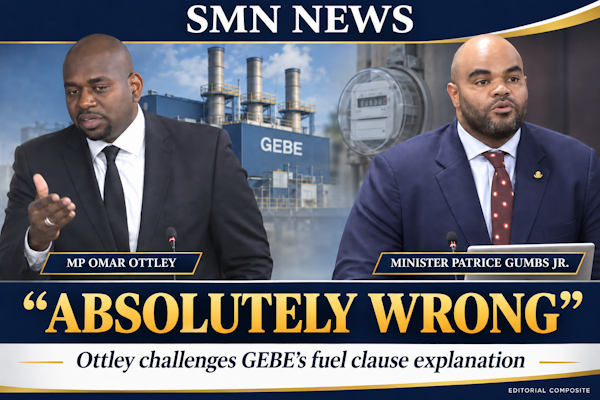 PHILIPSBURG:--- MP Omar Ottley interrupted Minister of VROMI Patrice Gumbs Jr. during the 2027 budget deliberations to sharply challenge GEBE’s explanation of its fuel clause, declaring that shifting costs into the charge because the company’s base rate is insufficient would be “absolutely wrong.”
The intervention came as Gumbs presented information supplied by GEBE explaining the distinction between its base electricity rate and fuel clause, including why it incorporated lubricants into the latter.
For Ottley, the explanation touched the central issue he had repeatedly raised: whether consumers were being charged through the fuel clause for expenses that should be addressed within the company’s operational cost structure.
“Nothing against you, Minister,” Ottley said, thanking Gumbs for bringing the explanation before Parliament while directing his criticism at the practice he believed it described.
GEBE Defends two separate charges
According to the explanation Gumbs read, GEBE recovers its electricity costs through two mechanisms.
The fuel clause covers heavy fuel oil, light fuel oil and lubricants, which the company described as products derived from crude oil.
The base rate covers other expenses, including maintenance, personnel, general costs, depreciation, financing and a reasonable profit.
GEBE’s position, as presented by the minister, is that the base rate no longer adequately covers those other costs because expenses have increased with inflation while the rate has not increased since 2011.
The company argued that removing lubricants from the fuel clause and placing them within the base rate would worsen its financial position because the base rate already fails to recover its existing costs.
That financial explanation did not satisfy Ottley.
Ottley: Reassess the Company’s Costs
Ottley said he had repeatedly argued that operational expenses belong within the base rate and that this position had been disputed during previous discussions with personnel.
He interpreted the explanation presented to Parliament as confirmation that insufficient recovery through the base rate was being used to justify costs remaining within the fuel clause.
“That is wrong. That is absolutely wrong,” he said.
Ottley argued that a company unable to maintain its costs must reassess and readjust its operations rather than shift the problem into the fuel clause.
His interruption was a political challenge to the explanation presented. It did not establish, through an audit or regulatory finding, that unrelated operational expenses had actually been inserted into the formula.
GEBE's explanation identified lubricants as a fuel-clause component and defended their classification as petroleum-derived inputs. The disagreement centered on whether that classification and the financial justification offered were appropriate.
Minister Traces Lubricants to 2010 Changes
Gumbs also relayed GEBE’s account of how the present arrangement developed.
According to that account, the company previously used a formula dating from the 1970s that was no longer functioning properly. A tariff study initiated in 2010 led to changes intended to simplify and correct the calculation, including incorporating lubricants into the fuel clause.
The explanation also referred to conditional approval by then-TEATT Minister Franklin Meyers and a reduction in the residential base rate.
These were historical claims presented on GEBE’s behalf. The exchange did not include the underlying study, approval documents or a detailed calculation showing the present financial effect of the lubricant component.
Review Continues, but no Reduction Announced
Asked what government was waiting for before acting on recommendations to amend the fuel clause, Gumbs said BTP was finalizing its review of the calculations.
He said the Minister of TEATT was also examining which recommendations could be implemented.
The objective, he explained, was to ensure that changes are substantiated, legally sound and beneficial to customers.
Gumbs also expressed support for regulating electricity through an LBHAM and said discussions with BTP were already taking place. Details would be shared with Parliament once finalized.
However, the response did not announce a revised formula, a confirmed reduction, a refund or an implementation date.
Ottley’s intervention sharpened the distinction Parliament must now examine: GEBE’s need to recover legitimate production costs, and the justification for recovering particular expenses through a fluctuating fuel clause.
For customers, the outstanding question is what the regulatory review will establish—and whether its conclusions will produce a measurable change on their electricity bills.