






The VROMI minister said safety concerns prompted work to begin. He confirmed that the private partner also had a building permit application before government and said the two matters were handled separately.
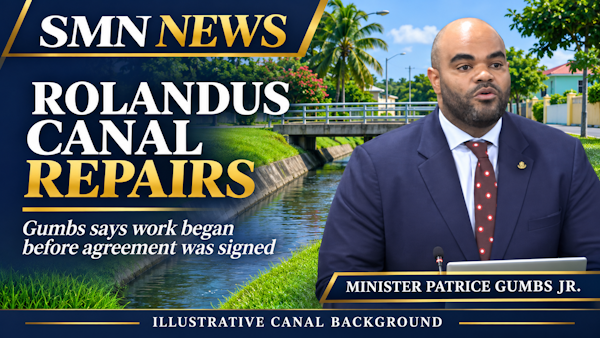 PHILIPSBURG:--- VROMI Minister Patrice Gumbs Jr. told Parliament on Monday that work on the privately backed canal project began before the public-private partnership agreement was signed. He said the work was started to reduce risks and improve residents’ safety. He also confirmed that the private entity supporting the project had submitted a building permit application to the government and denied that its participation influenced the permit decision.
Gumbs returned to Parliament on November 9 to answer 13 follow-up questions during debate on the draft 2027 budget. MPs Darryl York and Ardwell Irion pressed him on how the project was authorized, who bears the risk, how the contractor was selected, and what documentation Parliament could review.
Work underway while agreement remains unsigned
Irion asked Parliament for the signed agreement, even if it had to be shared confidentially. Gumbs said the document had not yet been signed. He said it would go to the Council of Ministers if signed.
Gumbs also confirmed that the government has no government-wide policy or framework for public-private partnerships. He described the document as a VROMI working framework that underwent initial legal vetting. Once finalized, he said, it would go to Legal Affairs before being presented to the Council of Ministers.
The minister said the ministry developed the framework in response to urgent infrastructure needs and a limited budget. He described the canal arrangement as a public-private partnership with some unusual features. The private entity provides most of the funding, while the government has contributed milled asphalt for a temporary road during construction, he said.
Gumbs said government retains oversight and must approve the work at each stage. He said construction risk rests outside government during the works, with risk and control passing to government upon completion. When Irion asked for the project’s insurance policy, Gumbs said it could not be shared. The minister did not identify a specific party responsible for defects discovered after handover.
Procurement, contractor selection and project costs
Irion asked whether Article 47 applied and who selected the contractor. Gumbs said the ministry had received legal advice and that, in his view, Article 47 did not apply because the country had not purchased goods or services under the arrangement.
He said private entities choose how to carry out construction, including whether to use a subcontractor. He denied directing the partner to hire a particular contractor.
Asked who had independently verified the cost, Gumbs said an estimate existed and that an independent third party would review spending and produce reports. He did not present a completed independent cost review to Parliament.
York, meanwhile, questioned whether Article 7.2 of the draft would require negotiation and mediation before government could terminate the agreement, even if a private partner breached it or abandoned the work. Gumbs said the document had been revised to include recourse to the Court of First Instance and arbitration if mediation failed. He also said a design-and-build project could fall within a public-private partnership, responding to York’s question about how the canal arrangement should be classified.
Blue Mall permit and demolition stop order
Gumbs said the application to renovate and redevelop the Blue Mall was submitted on March 7, 2025, and approved on July 17, 2026. He said the application met the requirements for approval and that a concern over setbacks was set aside because the building had already been permitted and had stood for years.
To support his account that the developer received no preferential treatment, Gumbs outlined how the ministry handled demolition work at the site in 2025. He said landfill security flagged an unusually large amount of demolition waste on August 6, and the landfill was instructed the following day to stop accepting that contractor’s demolition waste.
According to Gumbs, inspectors visited the site on August 20, confirmed that demolition was underway, and issued a warning followed by a stop order. A follow-up inspection took place on September 4. The contractor was instructed to separate steel from concrete and aluminum from sheetrock, send steel for recycling, and document the contents of each bin before disposal. Gumbs said the developer was also subject to labor inspections.
The minister said the permit application and the request for private support were handled separately. His account put the permit and enforcement dates on the parliamentary record. The signed partnership agreement and independent cost review remained outstanding at the close of his remarks.
Symbolic price considered for emergency homes
In a separate response to MP Veronica Jansen-Webster, Gumbs said government was considering charging a symbolic amount if it proceeds with selling the St. Peters and South Reward emergency homes to their occupants. He said any proceeds could be reinvested in housing. The proposal, including the price, had not yet been confirmed.