





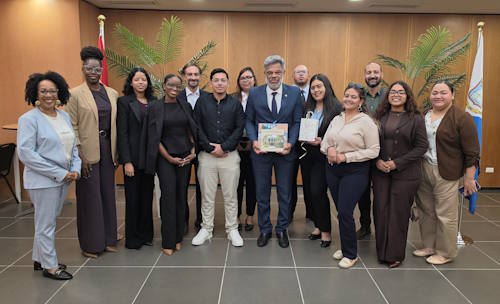
 PHILIPSBURG:--- Prime Minister Dr. Luc F.E. Mercelina welcomed a delegation from the University of Aruba’s Organization, Governance and Management (OGM) program for an engaging and thought-provoking dialogue on governance, leadership, inclusive nation-building and Kingdom relations.
The delegation, consisting of ten students accompanied by four faculty members, visited Sint Maarten as part of an educational excursion encompassing Sint Maarten, Saint-Martin, Sint Eustatius and Anguilla. The visit gave participants firsthand exposure to different constitutional arrangements, governance structures, and public administration practices across the Caribbean.
What began as an opportunity to learn more about Sint Maarten’s system of government developed into a lively exchange of ideas, with students posing critical questions, sharing observations and drawing comparisons between the governance experiences of Aruba and Sint Maarten.
During the discussion, Prime Minister Mercelina provided insight into Sint Maarten’s constitutional framework, including the separation of powers, the responsibilities of the Council of Ministers and the role of the Constitutional Court. He highlighted the distinctive position of Sint Maarten’s Constitutional Court within the Kingdom of the Netherlands and explained the challenges associated with maintaining the institutions and responsibilities of an autonomous country with a relatively small population.
The Prime Minister emphasized that effective governance requires more than sound legislation and institutional structures. It also demands capable professionals, strong leadership, integrity, accountability and a sustained commitment to strengthening public institutions.
A central theme of the dialogue was the importance of inclusiveness in building a shared national identity.
Drawing comparisons with Aruba’s strong sense of patriotism and national belonging, Prime Minister Mercelina reflected on Sint Maarten’s diverse population and the opportunities that come with being home to people from different cultural and national backgrounds.
He emphasized that nation-building must be an inclusive process, one that encourages everyone who calls Sint Maarten home to develop a sense of belonging, responsibility and commitment to the country's future.
“Nation-building is not simply about where we come from, but about the shared responsibility we accept for the country we call home. Our diversity is one of Sint Maarten’s greatest strengths, and it is through inclusion, mutual respect and collective ownership that we can build a stronger future,” Prime Minister Mercelina stated.
The discussion also explored the evolving relationship between the constituent countries of the Kingdom of the Netherlands. Prime Minister Mercelina shared his vision of moving from stakeholdership towards co-ownership, emphasizing the need for a Kingdom partnership rooted in mutual respect, equality, shared responsibility and meaningful cooperation.
He explained that while each country operates within its own constitutional realities, the Kingdom's strength ultimately depends on its ability to recognize the interests, aspirations, and contributions of all its constituent countries.
The Prime Minister stressed that Kingdom relations must extend beyond institutional arrangements and political discussions to deliver tangible benefits for the people they are intended to serve.
Education and leadership development also featured prominently throughout the exchange.
Prime Minister Mercelina encouraged the students to remain curious, challenge conventional thinking and recognize the value of education in shaping their professional and personal development. He emphasized that education should not simply prepare individuals for employment, but should equip them with the confidence, analytical abilities and critical thinking skills necessary to contribute meaningfully to society.
Reflecting on the achievements of Caribbean professionals and leaders, he encouraged the students to believe in their abilities and never underestimate the potential of individuals from small island communities to make a meaningful impact regionally and internationally.
The interactive session also addressed integrity within small island societies, the complexities of public administration, socioeconomic development, institutional capacity and opportunities for greater cooperation among Caribbean countries and territories.
Throughout the meeting, the students demonstrated enthusiasm and a willingness to engage in substantive discussions. Their questions and observations enriched the dialogue and highlighted the value of educational exchanges between neighboring Caribbean communities.
Prime Minister Mercelina expressed his appreciation to the University of Aruba delegation for their visit and commended the students for their thoughtful participation and interest in understanding the realities of governance beyond the classroom.
“Our Caribbean region needs young people who are prepared not only to ask difficult questions, but also to become part of the solutions. The future of our islands will depend on leaders who can think critically, work collaboratively and place the well-being of their people at the center of their decisions,” the Prime Minister remarked.
The visit concluded with a group photograph and an opportunity for further informal interaction between the Prime Minister, students and accompanying faculty members.
The engagement reaffirmed the importance of educational exchanges in strengthening regional understanding, encouraging meaningful dialogue and fostering greater appreciation for the opportunities and challenges shared by Caribbean societies.
For Prime Minister Mercelina, opportunities to engage directly with students reinforce the value of education, open dialogue and regional cooperation in building stronger institutions, more inclusive communities and a Kingdom partnership grounded in mutual respect and shared responsibility.