






TEATT Secretary-General Miguel de Weever advocates eliminating turnover and profit taxes, while former MP and Senior Policy Advisor Rolando Brison addresses international regulatory concerns.
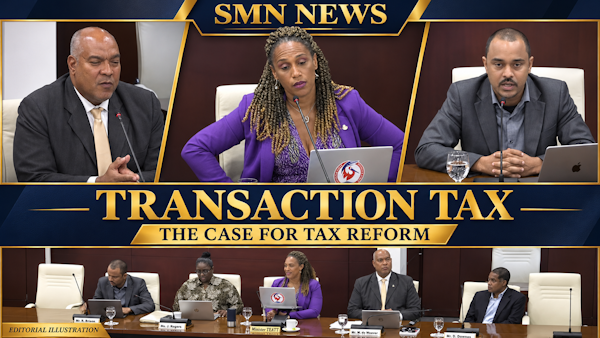 PHILIPSBURG:--- Minister of Tourism, Economic Affairs, Transport and Telecommunication (TEATT) Grisha Heyliger-Marten presented an ambitious proposal to Parliament on Wednesday that could fundamentally restructure Sint Maarten's taxation system, potentially eliminate several existing taxes, significantly reduce wage taxes and broaden the country's revenue base through a Financial Transaction Tax (FTT).
The minister appeared before Parliament's committee alongside her technical and advisory team, comprising:
- Miguel de Weever, Secretary-General of TEATT and lead on the Financial Transaction Tax initiative.
- Rolando Brison, former Member of Parliament and current Senior Policy Advisor.
- Jessica Rogers, Senior Policy Advisor to TEATT's Cabinet.
- A financial consultant and former Windward Islands Bank executive.
The parliamentary meeting was requested on September 30, 2026, to examine the government's research, preliminary findings, institutional consultations and potential direction for the proposed tax reform.
Heyliger-Marten said the government had undertaken about two years of exploratory work, producing findings her ministry believes warrant further investigation.
From Existing Taxes to a Financial Transaction Tax
Heyliger-Marten argued that Sint Maarten must reconsider how it generates revenue if the government intends to adequately finance education, healthcare, infrastructure, public safety and economic development.
She identified six principal challenges affecting the existing taxation system, which she described as the six Cs.
- Cash flow
- Compliance
- Collection
- Cost
- Confidence
- Complexity
According to the minister, the existing system imposes administrative burdens on businesses while requiring considerable government resources for monitoring, collection, auditing and enforcement.
A Financial Transaction Tax would potentially allow the government to collect revenue directly through qualifying financial transactions processed by financial institutions and payment systems.
Transactions being examined include bank transfers, ATM transactions, debit and credit card payments, online purchases and point-of-sale payments.
However, the taxable categories, exemptions and applicable rates remain subject to further research.
Cg. 11.816 Billion in Financial Transactions
One of the most significant figures presented to Parliament was the historical payment transaction volume recorded during 2022.
According to the ministry's analysis, approximately 11.816 billion guilders moved through the payment system during that year.
Applying an illustrative tax rate of 5% to that volume produces a theoretical gross revenue figure of 590.8 million guilders.
|
Historical analysis |
Amount |
|
Recorded financial transactions in 2022 |
11.816 billion guilders |
|
Illustrative transaction tax rate |
5% |
|
Theoretical gross transaction tax revenue |
590.8 million guilders |
|
Actual government revenue in 2022 |
454.7 million guilders |
|
Illustrative difference |
136.1 million guilders |
The minister stressed that financial transaction volumes may include multiple movements of the same funds, overlapping payment channels and transactions that could ultimately qualify for exemptions.
The 590.8-million-guilder figure therefore remains an illustrative calculation requiring considerable refinement before it can serve as a credible government revenue forecast.
Parliament was presented with a potential revenue opportunity of considerable magnitude, but the government must still establish how much of the recorded transaction volume would realistically be taxable.
Wage Tax Could Be Reduced by 50%, While TOT and Profit Tax Could Be Eliminated
Perhaps the most consequential aspect of Wednesday's presentation was the possibility of restructuring or eliminating several of Sint Maarten's principal taxes.
Heyliger-Marten presented an illustrative model using 2024 government revenue figures.
|
Existing revenue source |
2024 revenue |
Illustrative reform |
|
Wage tax |
183.8 million |
Reduce by 50% |
|
Turnover tax (TOT) |
159.5 million |
Eliminate |
|
1% license fee |
32.6 million |
Eliminate |
|
Profit tax |
28.4 million |
Eliminate |
|
Transfer tax |
13.4 million |
Retain |
|
Total |
417.7 million |
Under this scenario, approximately 105.3 million guilders in revenue from these five sources would remain, while approximately 312.4 million guilders would have to be replaced.
The minister's presentation reported slightly different rounded totals of approximately 417.8 million and 312.5 million guilders respectively.
If a carefully designed transaction tax could replace revenue from the taxes identified for reduction or elimination, the reform could substantially alter the financial obligations of employees, employers, and investors.
However, the historical transaction figures relate to 2022, while the existing tax revenues relate to 2024. A consistent financial model using comparable periods will be necessary.
Miguel de Weever Advocates Eliminating TOT and Profit Tax
TEATT Secretary-General Miguel de Weever made a particularly strong case for restructuring the country's tax system.
De Weever maintained that introducing a Financial Transaction Tax should be accompanied by substantial tax relief for businesses and individuals.
He advocated eliminating turnover tax and profit tax while significantly reducing income and wage taxes.
According to De Weever, such reforms could:
- Increase workers' disposable income.
- Improve business cash flow.
- Reduce administrative compliance costs.
- Encourage business expansion.
- Attract additional foreign and domestic investments.
- Create employment opportunities.
- Provide opportunities to increase the minimum wage.
He argued that improved business profitability and liquidity could give employers greater financial capacity to raise wages.
The economic objective, according to De Weever, would be to ensure households and businesses retain more money under the proposed system than they currently retain under the existing taxation framework.
The net financial position of workers and businesses would therefore be a central test of whether the proposed reform is successful.
Government Could Collect Revenue Directly Through the Banking System
De Weever also highlighted the potential administrative advantages of collecting taxes through financial institutions.
Under the existing turnover tax framework, businesses have reporting, filing, and remittance obligations, requiring government authorities to monitor thousands of taxpayers.
A transaction-based collection mechanism could potentially concentrate much of the revenue collection process within a smaller number of regulated financial institutions.
De Weever pointed to the existing 1% license fee collection system as an example of how revenue can be remitted to the government through the Central Bank.
He argued that a Financial Transaction Tax could give the government more predictable monthly revenue, improve transparency, and reduce the administrative resources required to pursue outstanding payments.
However, the minister acknowledged that financial institutions would need to assess the operational and technological requirements of such a system, including settlement procedures, remittance arrangements, refunds and transaction reversals.
Shifting More of the Tax Burden Toward Visitors
Heyliger-Marten expressed particular interest in broadening the country's tax base by capturing revenue from the millions of visitors who annually utilize Sint Maarten's infrastructure and tourism services.
The minister argued that the country's relatively small resident population currently bears a substantial share of the cost of public services and infrastructure.
Financial transactions conducted by visitors, including qualifying card payments, could potentially contribute more directly to government revenue.
De Weever also highlighted tourism expenditure as a significant opportunity to increase revenue collection through payment systems.
The proposed approach reflects an ambition to broaden participation in financing public services while creating greater disposable income for residents.
The actual distribution of that burden will depend on the final design of the tax, tourist spending patterns, exemptions and the extent to which businesses pass additional costs on to customers.
Former MP Rolando Brison Addresses IMF, OECD and FATF Concerns
Former Member of Parliament Rolando Brison, now a Senior Policy Advisor, addressed the international regulatory implications of the proposed Financial Transaction Tax.
Brison referenced the positions and recommendations of several international institutions.
- International Monetary Fund (IMF).
- Organization for Economic Co-operation and Development (OECD).
- Financial Action Task Force (FATF).
He argued that Sint Maarten has unique economic characteristics that should be considered when assessing the suitability of alternative taxation systems.
According to Brison, the IMF initially strongly opposed introducing a Financial Transaction Tax when it examined the proposal in 2021.
Following further research and discussions with the IMF in June 2025, the ministry believes it has made progress in addressing some of the concerns raised by the international institution.
Heyliger-Marten nevertheless acknowledged that the IMF continued to characterize bank transaction taxation as highly distortionary and regressive in its September 2025 assessment.
The minister emphasized that the IMF's subsequent position should not be interpreted as an endorsement.
Brison Challenges Arguments About Regressive Taxation
Brison also challenged the argument that a Financial Transaction Tax would necessarily make Sint Maarten's taxation system more regressive.
He pointed to estimates of tax compliance ranging between 30% and 40%, which he attributed to the Committee for Financial Supervision (Cft).
Brison argued that existing compliance deficiencies place a disproportionate burden on salaried employees and compliant businesses, while individuals and entities that fail to meet their obligations contribute substantially less.
He maintained that broader transaction-based collection could improve compliance and distribute the financial responsibility among more economic participants.
Brison also argued that reducing wage taxation, increasing minimum wages, and improving workers' purchasing power could help address the distributional concerns associated with the proposed transaction tax.
He further discussed international corporate taxation standards and the possibility of substantially reducing domestic profit taxes.
Whether these objectives can be achieved while maintaining compliance with international tax, financial transparency, and anti-money laundering standards will require detailed legal and technical assessment.
Could the Transaction Tax Increase the Cost of Living?
Despite the potential benefits outlined by the TEATT team, concerns surrounding the proposed reform remain considerable.
One principal issue is cascading taxation, where a product could accumulate additional costs at various stages of the commercial supply chain.
For example, an imported product may involve transactions between an importer, wholesaler, retailer, and final consumer. Depending on the proposed tax structure, multiple qualifying payments could increase the final cost.
De Weever argued that Sint Maarten's relatively short supply chains and limited manufacturing sector could reduce some of these concerns compared with larger industrialized economies.
The ministry is also examining how customs information and improved import monitoring could help the government assess pricing practices.
Nevertheless, the government will need to demonstrate how the proposed system would protect minimum-wage earners, pensioners, vulnerable households and businesses operating with narrow profit margins.
Additional questions concern the potential treatment of:
- Mortgage and loan repayments.
- Transfers between personal bank accounts.
- Salary payments.
- Pension deposits.
- Insurance settlements.
- Overseas remittances.
- Business-to-business payments.
- Essential household expenditures.
- Refunds and reversed transactions.
- Cross-border payments.
None of these transaction categories has yet been assigned a definitive tax treatment under the proposed reform.
Heyliger-Marten Envisions a One-Billion-Guilder National Budget
Beyond the Financial Transaction Tax, Heyliger-Marten outlined a broader strategy involving five areas of revenue reform.
|
Revenue initiative |
Measures under consideration |
|
Structural taxation reform |
Financial Transaction Tax and restructuring existing taxes |
|
Visitor contributions |
Potential tourist entry fee |
|
Accommodation taxation |
Increase and broaden coverage to vacation rentals |
|
Regulated products |
Tobacco excise and potential cannabis taxation and licensing |
|
Maritime economy |
Registration, mooring and other applicable fees |
The minister reiterated her ambition of eventually achieving a national budget of one billion guilders through a combination of these measures.
She also referred to proposed accommodation tax reforms, including examining an increase from 5% to 10% and extending coverage to short-term rentals marketed through Airbnb and VRBO.
Such a revenue strategy could fundamentally change the scale of government's financial resources if the measures prove viable and deliver the anticipated results.
The one-billion-guilder figure remains a policy ambition requiring validated revenue estimates and legislative approval.
MP Dimar Labega Calls for Real-Life Business Simulations
During the initial parliamentary questioning, Democratic Party MP Dimar Labega proposed conducting a practical simulation involving approximately 50 to 100 businesses.
Labega suggested that such an exercise could provide realistic information concerning spending patterns, consumer behavior, business transactions and operational challenges.
His proposal could enable the government to identify potential weaknesses and unintended consequences before introducing any legislation.
A simulation involving businesses from various economic sectors would also allow researchers to assess whether the proposed tax produces the intended benefits under realistic commercial conditions.
Seven-Step Roadmap for Further Research
Heyliger-Marten outlined seven proposed stages for advancing the initiative:
- Update and reconcile financial transaction data.
- Model different tax rates, taxable bases and tax replacement scenarios.
- Assess the impact on households, businesses and government finances.
- Develop exemptions, safeguards and collection arrangements.
- Consult financial institutions, the Ministry of Finance, businesses, labor organizations and civil society.
- Refine the preferred model based on research and stakeholder feedback.
- Return to government and Parliament with the findings for further consideration.
The minister indicated that the final tax rate, implementation timeline, exemptions, collection procedures and household protection measures remain outstanding.
A Fundamental Economic Reform Requiring Extensive Scrutiny
Wednesday's parliamentary presentation represents one of the most extensive public discussions on restructuring Sint Maarten's taxation system in recent years.
The possibility of eliminating turnover tax and profit tax, halving wage tax, and collecting revenue through financial institutions could have considerable implications for virtually every resident and business.
However, the benefits envisioned by the TEATT team will depend on whether its financial assumptions withstand independent economic analysis.
Critical questions remain concerning the impact on household purchasing power, banking costs, investment, consumer prices, tax compliance and government revenue stability.
Parliament must also establish whether the Ministries of Finance and TEATT share a unified position on the proposed restructuring and how the government intends to manage the transition from existing taxation mechanisms.
For Sint Maarten's residents, the fundamental question remains whether this proposed transformation will genuinely leave more money in their pockets while providing the government with sufficient revenue to meet its obligations.
That is the challenge Heyliger-Marten, De Weever, Brison and the wider technical team must now address through credible economic modeling, transparent consultations and measurable evidence.