Dear Editor,
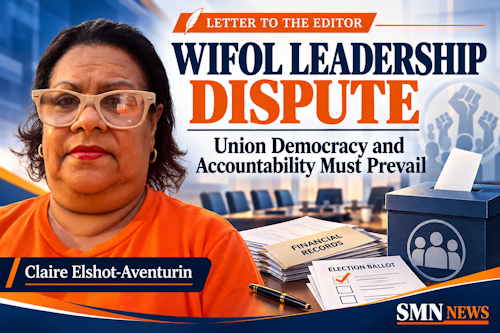 I request space in your publication to address what I consider a deeply troubling takeover of WIFOL union leadership. In my view, the circumstances raise serious questions about democratic procedures, membership eligibility, financial accountability, and respect for the union’s constitution and bylaws.
Before explaining my concerns, allow me to establish the experience from which I speak. I served as President of WITU for 27 and a half years and have 47 years of experience as a teacher. I also served three terms as President of WICLU.
I am a member of the C.C.S.U., formerly the GOA, and previously served on the Tripartite Committee, where government, labor, and business were represented as equal partners. I have supported local trade unions in their struggles for workers’ rights, including the efforts that led to the establishment of WIHCUA, an independent union representing healthcare workers. I also supported justice workers in their struggle over their legal employment status following October 10, 2010.
My trade union training includes programmes in the Dominican Republic and Venezuela under CLAT, congresses organized by Education International in Bulgaria and Argentina, and activities with FLATEC in Spain. Through the Caribbean Union of Teachers, I have also participated in training and strengthened regional ties in Antigua, Trinidad, Grenada, Saint Vincent, Saint Lucia, Anguilla, Barbados, Bermuda, the Bahamas, Belize, Jamaica, and Guyana.
I share this background because I have spent decades committed to workers and the trade union movement. When something is wrong, we must address it. The lessons learned should help build stronger, healthier organizations for current members and future generations.
I have decided to break my silence because I believe the actions surrounding WIFOL’s leadership change threaten the principles that trade unions should defend. Yet too many people have remained silent.
Why I regard this as a leadership coup
When I use the term “coup,” I mean a leadership change that, in my view, bypasses established democratic procedures and concentrates control in the hands of a small group.
The concerns include whether the union’s constitution and bylaws were followed, whether pressure or intimidation was used, whether the dues-paying membership meaningfully participated, and whether a properly constituted meeting authorized the replacement of the leadership.
A union belongs to its members. Its leadership must derive authority from a transparent, legitimate process. No individual or group should be allowed to disregard the rules while claiming the authority those same rules are meant to confer.
What should have preceded the October congress?
My understanding is that a WIFOL congress was being planned for October 2026. A properly organized congress requires preparation, documentation, and clear procedures.
First, the secretariat should prepare a report summarizing the union’s activities during the relevant term. Members should receive that report at least one week before the congress.
Second, the Secretary of Finance should prepare a financial report. Members should submit receipts, contracts, bank statements, and other supporting documents for an independent audit. The organization should pay for that audit, and the resulting report should be circulated to members before the congress.
Third, members should receive formal notice of the congress and a clear nomination deadline. Board-position eligibility must comply with the union’s constitution and bylaws, including applicable membership and dues requirements. Outsiders or non-members should not occupy positions reserved for eligible members.
Fourth, the agenda should clearly state that elections will take place. Nominations should be completed beforehand, and ballots should identify the candidates.
Fifth, an independent election committee should conduct the election. The outgoing board should step aside from administering that process. The committee should verify the quorum, distribute ballots, oversee a secret vote, count the votes, and announce the results.
My understanding is that the quorum consists of half the total dues-paying membership plus one, subject to the union’s governing rules.
Were these procedures followed? Where are the records demonstrating that they were?
Questions about membership and eligibility
The announcement of the new board raises questions that deserve direct answers.
Is Joanice Richardson, identified as the newly elected President, a member of WIFOL? Is he a dues-paying member, and did he meet the requirements to stand for election?
The same questions apply to Elton Jones. Is he a WIFOL member, and did he meet the applicable membership and dues requirements?
These are fundamental questions about the process's legitimacy. Members are entitled to clear answers supported by the union’s records.
Ashma Berkel and the unfinished financial audit
The questions surrounding Ashma Berkel are different. She worked closely with Mr. Thompson and served as WIFOL's Secretary of Finance, which also includes the CISCEF training institute.
She is now part of the new team. That makes explaining her role especially important.
At the time of the disputed leadership change, an auditor was already examining documents and receipts to prepare an audited financial report for the planned October congress.
Was Ms. Berkel aware of that work? Based on her position and responsibilities, I believe she was.
Why, then, was the auditor subsequently informed that persons affiliated with the former WIFOL board could no longer access documents? Why were instructions issued restricting entry to offices and preventing further collection of the records needed to complete the audit?
Preparing those financial records fell, at least in part, within her responsibilities. An unfinished audit requires cooperation and access to supporting documents. Members deserve an explanation of any decision that prevented that work from being completed.
René Richardson’s statement
The auditor also received two stern notices from Mr. René Richardson. Following those notices, he made the following statement:
“I know the corrupt scammer well. That is why I sent those messages.”
I was deeply disappointed by those words. Such a serious accusation should be supported by evidence. It should never replace a proper explanation for why an auditor’s work was interrupted or why access to financial records was restricted.
For someone returning to a prominent role in union affairs after years away from the forefront of defending workers’ rights, that statement is particularly troubling.
I also question how his advisory work with companies after his political career as a commissioner aligns with the position he now takes in this dispute.
My advice is simple: those who live in glass houses should not throw stones. The windows they break may be their own.
Restore a fair and transparent process
I am calling for the disputed leadership change to be examined against WIFOL’s constitution and bylaws. If the process failed to meet those requirements, it should be set aside, and a properly constituted congress and election should be organized.
The financial audit should be completed, relevant records should be preserved and made available for that work, and members should receive the information they need to make informed decisions.
This matter must be resolved through lawful, transparent, and democratic means. Workers’ representation is too important to be undermined by personal attacks, unanswered questions, or procedures that members cannot scrutinize.
Trade unions across Sint Maarten must speak up. We cannot demand accountability from employers and government while remaining silent when serious questions arise within our own movement.
Wake up, trade unions of Sint Maarten. Stand up for workers’ rights, union democracy, and accountability.
Thank you.
Mrs. Claire Elshot-Aventurin
A trade unionist at heart








 MP Francisco Lacroes has suggested charging motorists 25 or 50 cents to use the Simpson Bay Causeway. He argues that many people crossing the bridge live on the French side, while Sint Maarten pays the cost.
 To the Lieutenant-Governor of the Island Territory of Bonaire, Mr G.Thode
 This recent backroom meeting, as SMN News called it, between SOL, the Prime Minister, and several MPs is yet another reminder: if you did not know it already, you should know it now. In my view, these politicians do not actually care about finding a real solution. They care about getting glory for selling false hope or using meetings like this for political posturing. Let me explain.