~Judge finds no proof of fraud, no proof of abuse, no proof of procurement manipulation.~
 PHILIPSBURG:--- In a devastating rebuke of the Government of St. Maarten's disciplinary process, the Court in Civil Servant Matters has completely overturned the dismissal of Althea Charlotte Maria Richardson, ruling that the Government failed to prove allegations of fraud, abuse of office, procurement manipulation, or serious misconduct despite dismissing the veteran civil servant on those grounds.
The judgment, issued on July 6, 2026, dismantles virtually every major allegation used to justify Richardson's dismissal and concludes that the investigation conducted by the Government and Forensic Caribbean lacked the factual foundation necessary to sustain the most severe disciplinary penalty available under the law.
The Court declared Richardson's objection well-founded, annulled the Governor's National Decree dismissing her, ordered Government to resume paying her salary retroactively from September 2025, and ordered Government to pay CG 1,400 in legal costs.
Government Alleged Years of Procurement Fraud
Richardson, who has served the Government since 1997, worked as Head of Employee Procurement and Management within the Department of Facility Affairs after assuming that position in March 2017.
Government launched an internal investigation in July 2024 after concerns arose regarding procurement practices and budget management within the department. Richardson was removed from active duty on July 22, 2024, later suspended, and ultimately dismissed after investigators alleged that the procurement process had been manipulated for years.
The government accused Richardson of:
• manipulating procurement procedures;
• steering contracts toward preferred suppliers;
• forwarding competing quotations to vendors;
• advising suppliers how to submit bids;
• purchasing goods at inflated prices;
• failing to verify suppliers;
• signing for goods allegedly never delivered; and
• using her position to defraud Government.
Judge: Those Serious Allegations Were Never Proven
The Court's ruling leaves little doubt about its assessment of those accusations.
The judge ruled that allegations of fraud and abuse require solid factual evidence because they are extremely serious accusations against a public servant.
Instead, the Court found that the investigation repeatedly relied on speculative language such as "possibly," "presumably," "appears to indicate," "could have," and "strengthens the impression."
According to the Court, those expressions may suggest suspicion, but they do not establish facts.
The judgment concludes that investigators never produced concrete evidence proving Richardson committed fraud or abused her office.
Government had no Procurement Rules
One of the most damaging findings concerns the Government's own procurement system.
While Government accused Richardson of violating procurement procedures, the Court found that investigators themselves acknowledged that clear procurement procedures, work instructions and formal responsibility assignments simply did not exist within the Department of Facility Affairs.
The investigation revealed there were no established procedures governing:
• placing purchase orders;
• selecting suppliers;
• determining which vendors should receive government business;
• evaluating quotations;
• verifying suppliers; or
• defining who was responsible for procurement decisions.
The Court ruled that while Richardson held an important position with significant responsibilities, Government could not hold her solely responsible for violating procedures that were never clearly established.
No Evidence Richardson Chose Suppliers
Government also claimed Richardson improperly selected suppliers.
The Court rejected that argument.
The judgment states investigators never established that Richardson independently selected suppliers or possessed final decision-making authority over which companies received contracts.
Richardson maintained throughout the proceedings that many of the suppliers were already doing business with Government before she assumed her position, that she followed instructions from her supervisors, and that several alternative suppliers had stopped doing business with Government because of outstanding debts.
The Court noted Government failed to effectively dispute those explanations.
High Prices alone do not Prove Misconduct
Although investigators pointed to invoices showing significant price differences, the Court ruled that inflated prices alone do not establish misconduct.
According to the judgment, Government failed to provide quotations, comparison studies, procurement analyses or other documentation demonstrating how purchasing decisions were made, what alternatives existed, or what specific role Richardson played in determining prices.
Without that evidence, the Court ruled that the allegation could not stand.
Investigation Criticized for Procedural Failures
The Court was equally critical of the manner in which the disciplinary investigation was conducted.
Forensic Caribbean prepared only a draft report, which Richardson challenged in detail.
However, the Court found no evidence that investigators ever finalized the report after considering her responses.
Nor was there any indication that her objections were meaningfully incorporated into the final decision to dismiss her.
The Court described that omission as an important procedural defect because the draft report formed the factual basis for the dismissal. Without a properly finalized report, the Court found it impossible to determine whether investigators had reconsidered any of Richardson's objections before Government terminated her employment.
Fraud Allegations Collapse
Perhaps the strongest language in the judgment concerns the accusation that Richardson defrauded Government.
The Court ruled that her involvement in an unclear procurement process, maintaining supplier contacts, processing documents or signing paperwork does not, by itself, establish fraud.
Instead, Government would have needed to prove precisely:
• what Richardson actually did;
• what knowledge she possessed;
• how her conduct facilitated fraud; and
• how her actions directly contributed to unlawful procurement.
The Court concluded that investigators failed to establish those essential facts.
Dismissal set aside
Having found the factual basis for the allegations insufficient, the Court ruled that Government failed to prove the serious misconduct necessary to justify dismissal under the Landsverordening Materieel Ambtenarenrecht.
The disciplinary dismissal was therefore annulled in its entirety.
As a result, Government must restore Richardson's salary effective September 2025 and reimburse her legal expenses.
The ruling represents one of the strongest judicial criticisms in recent years of a Government disciplinary investigation. Rather than finding procedural technicalities, the Court concluded that the allegations of fraud, abuse, and procurement manipulation were not supported by sufficient evidence, thereby making Richardson's dismissal unlawful.
Statement by Althea Charlotte Maria Richardson
Following the Court's decision to overturn her dismissal, former Head Employee Procurement and Management Althea Charlotte Maria Richardson issued the following statement:
"I am more than happy that my name has finally been cleared by a court of law. From the very inception of this matter, I maintained my innocence and consistently stated that I had committed no wrongdoing.
Despite my financial situation here on St. Maarten, I have never committed any illegal acts or engaged in dishonest conduct. My integrity has always meant everything to me, and today's judgment confirms what I have been saying all along.
This has been an extremely difficult period in my life. Losing my income placed tremendous financial strain on me as I continued to care for my elderly mother and support my daughter, who is pursuing her studies abroad. It has been an emotional and financial burden that no one should have to endure.
With this victory, I want to publicly express my sincere gratitude to the Windward Islands Civil Servants and Private Sector Union (WICSU-PSU) and its President, Sharon Cangieter, for standing by me throughout this ordeal. Their unwavering support gave me the strength to continue fighting for justice.
I also wish to extend my heartfelt appreciation to my attorney, Peggy Ann Brandon, and Caroline Gibbes, whose professionalism, dedication, and belief in my case were instrumental in achieving this outcome.
Finally, I want to thank my colleagues, friends, and everyone who supported and encouraged me during this very challenging chapter of my life. Your prayers, kindness, and confidence in me helped me persevere. While this ordeal can never give me back the time and hardship I have endured, I am grateful that justice has prevailed and that my name has been vindicated."
 PHILIPSBURG:--- Member of Parliament Omar Ottley is calling on the Government of St. Maarten to take immediate action to provide meaningful relief to the people by reducing GEBE’s base tariff, especially in light of the recently announced increase in the fuel clause.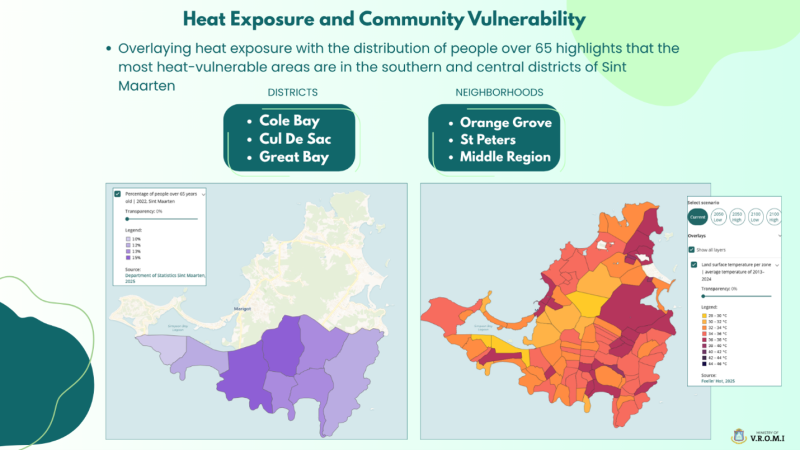
 Through the Climate Impact Atlas, users can:
 PHILIPSBURG:--- NV GEBE wishes to inform the community that the electricity fuel clause has been increased to XCG 0.49, effective today, July 10, 2026. This increase will be reflected on the July 2026 electricity invoices, which are scheduled to be distributed beginning Monday, July 13, 2026.
 Caribbean Sea:--- Premios Verdes has recognized Caribbean Marine Conservation through Community Conservation at the Alligator Head Foundation in Jamaica, the Caribbean Shark Coalition in the wider Caribbean, and the UNESCO IOC Ocean Decade Task Force as part of its regional platform highlighting social and environmental initiatives from Latin America and the Caribbean.