




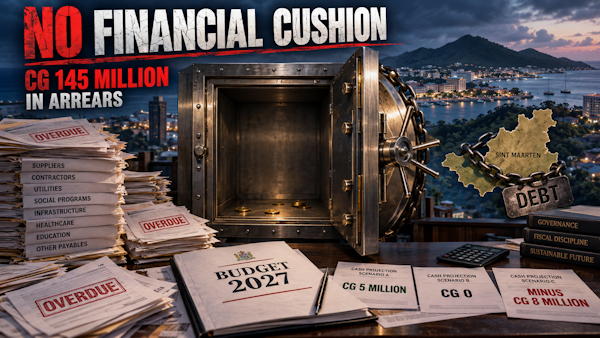
 PHILIPSBURG:--- Sint Maarten is heading into 2027 without the financial cushion needed to absorb an emergency, introduce new policies, or confront the growing risks at SZV, TelEm, GEBE, and Postal Services Sint Maarten.
Behind the government’s projected budget surplus lies a far more troubling reality: approximately Cg 145 million in payment arrears, conflicting cash projections and hundreds of millions of guilders in unresolved liabilities.
The Committee for Financial Supervision (Cft) delivers the warning bluntly in its assessment of the draft 2027 budget: Sint Maarten has no liquidity to absorb unexpected setbacks or introduce new policies.
That warning strikes at the credibility of the government’s plans. A budget may appear balanced on paper, but paper cannot pay overdue bills, finance emergency measures, or rescue a government-owned company that suddenly cannot meet its obligations.
Three different cash projections in one Budget
The government’s financial planning is immediately called into question by three conflicting liquidity projections in the budget documents.
For the end of 2027, the documents reportedly present:
- One projection showing Cg 5 million in available cash;
- Another table showing zero available cash; and
- Accompanying text referring to a negative cash balance of Cg 8 million.
These are not minor typographical differences. They represent three fundamentally different pictures of the government’s ability to meet its obligations.
One projection suggests that Sint Maarten will have a small buffer. Another says there will be no buffer at all. The third suggests the government will already be in the red.
The Cft demanded more consistent and reliable liquidity projections, warning that the figures vary too frequently between budget documents without adequate explanation.
Parliament cannot meaningfully approve a national budget if it cannot determine whether government expects to end 2027 with a Cg 5 million, nothing, or a Cg 8 million deficit.
Cg 145 million in Payment Arrears
Even the most favorable projection of Cg 5 million in available cash is overwhelmed by approximately Cg 145 million in payment arrears.
The Cft concluded that improving the cash position and eliminating those arrears will require the government to generate new revenue or control expenditure. It called for a clear and executable plan.
Government’s response is to pursue stronger tax compliance, introduce a tourist tax, optimize fees and licenses and maintain strict expenditure controls.
But this response raises another central question: how much of the financial burden will ultimately be shifted onto residents, businesses and visitors?
The government is promising possible reductions in certain direct and indirect taxes to improve purchasing power. At the same time, it is relying on improved tax collection, a new tourist tax and higher or optimized fees to strengthen its finances.
Without exact calculations, implementation dates and an assessment of who will pay more or less, the public is left with promises on one side and new revenue demands on the other.
Another loan while previous investments remain unfinished
The 2027 budget contains plans for another major capital loan while approximately Cg 200 million in investments approved in earlier years remain unexecuted.
According to the Cft, Sint Maarten is already paying approximately Cg 5.5 million in interest on the loans connected to those outstanding investments.
The proposed new borrowing would add roughly another Cg 2 million in interest costs.
Borrowing for productive national development can be justified. Borrowing money, paying interest and then failing to execute the projects cannot.
The Cft warned that the draft budget does not clearly show which investments correspond with the new loan request. It also noted that the investment totals do not reconcile properly and that the government again failed to provide the repeatedly requested multi-year investment agenda.
Parliament is therefore being asked to consider further borrowing without a clear and complete accounting of what happened to hundreds of millions already designated for investment.
Debt estimated at Cg 1.424 billion
The Cft estimates that Sint Maarten’s central government debt, including short-term liabilities, will reach approximately Cg 1.424 billion by the end of 2027—equal to roughly 41% of gross domestic product.
That figure does not stand alone.
The country also faces:
- Approximately Cg 500 million in accumulated debt between SZV’s healthcare and social funds;
- More than Cg 100 million owed directly by government to SZV;
- A Cg 75.6 million loan contracted on behalf of GEBE;
- A requested Cg 5 million government guarantee for TelEm;
- Approximately Cg 145 million in payment arrears; and
- Possible future financial assistance for PSS.
Not every amount can simply be added together, because some obligations may overlap or carry different legal and accounting classifications. Nevertheless, taken collectively, they reveal the enormous pressure surrounding the government’s finances.
SZV could exhaust its liquid reserves
The healthcare funds are projected to record annual deficits of about Cg 35 million between 2027 and 2030, while SZV is expected to run annual operational deficits of about Cg 20 million.
Even after using surpluses from other social funds, SZV could still lose between Cg 15 million and Cg 25 million annually.
The Cft warns that SZV’s liquid reserves could be exhausted within several years.
The government has responded with broad commitments to improve oversight, financial management and revenue collection. It is also advancing General Health Insurance, a tourist tax and a proposed fluctuation fund.
However, the budget does not present a complete, legally secure and fully financed solution to the problem.
Instead, the current system still depends partly on cross-financing between funds—an arrangement the Cft questions on legal grounds.
Government companies waiting at the treasury’s door
TelEm, GEBE and PSS are all identified as companies with serious financial problems.
GEBE lacks completed financial reporting for 2023, 2024 and 2025, while its liquidity and equity are believed to have deteriorated. TelEm has difficulty meeting obligations to lenders and has requested a government guarantee. PSS continues to survive through additional operational contributions.
These companies provide essential public services. Allowing them to fail is hardly an option, meaning their financial problems can rapidly become the government’s—and therefore the taxpayers’—problems.
Yet the government has not established budgetary provisions for the possible TelEm guarantee or future assistance to PSS. It says it can address any financial consequences later through budget amendments.
That approach does not eliminate the risks. It merely leaves them outside the current budget until the bills come due.
Parliament must demand one honest financial picture
The draft 2027 budget is presented as a roadmap for another fiscal year. However, the documents reveal a government with limited cash, massive arrears, unresolved healthcare obligations, financially distressed public companies, and plans for additional borrowing.
The figures demand more than ceremonial speeches and political assurances.
Before approving the budget, Parliament should insist on:
- One verified liquidity projection;
- A payment schedule for the Cg 145 million in arrears;
- A legally supported plan for the SZV deficits and accumulated debts;
- Current financial statements from GEBE;
- Full disclosure of the TelEm guarantee and proposed building purchase;
- A clear plan for PSS;
- A reconciliation of all proposed capital investments; and
- A complete explanation of what happened to approximately Cg 200 million in previously planned investments.
A country with no emergency cushion cannot afford financial ambiguity.
Sint Maarten’s 2027 budget does not merely expose a shortage of money. It exposes a shortage of reliable information, completed accounts and enforceable solutions—and Parliament must not pretend that projected revenue on paper makes those dangers disappear.
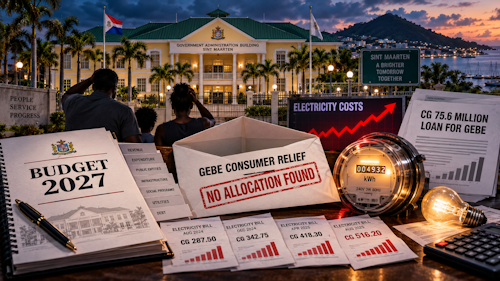 PHILIPSBURG:--- The Government of St Maarten’s draft 2027 budget contains no clearly identified allocation for the long-promised relief to GEBE consumers struggling under high electricity bills, disputed accounts and accumulated utility debt.
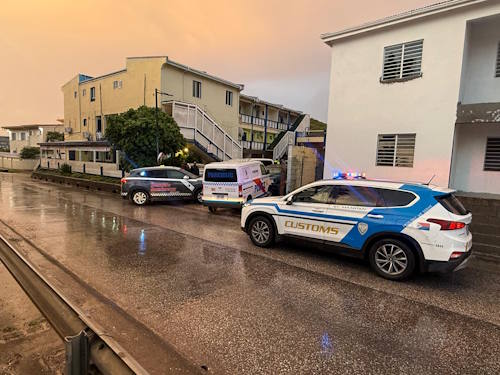 PHILIPSBURG:--- The Police Force of Sint Maarten (KPSM), in close cooperation with the Customs Department, Koninklijke Marechaussee (KMAR), and the Immigration Department of Sint Maarten, carried out a coordinated enforcement action at a hotel establishment in the Cay Hill area.