~Budget presentation exposes fragile liquidity, billion-guilder debt, healthcare deficits, and state-owned companies that could force the government back into crisis mode.~
 PHILIPSBURG:--- While Finance Minister Marinka Gumbs presented a 2026 budget with a projected Cg 11 million operational surplus, the deeper figures in government’s own presentation show that St. Maarten’s public finances remain exposed to serious risks that could wipe out that surplus quickly.
The budget projects Cg 647 million in revenue and Cg 636 million in operating expenditure. On paper, that gives the government a positive balance. But the fiscal risk section paints a far more fragile picture: healthcare funds are bleeding money, several state-owned companies remain weak, liquidity is thin, debt remains above one billion guilders, and one major hurricane could severely damage the government’s financial position.
Government’s opening debt for January 2026 is listed at Cg 1.021 billion. A new Cg 42 million capital loan is planned for 2026, while repayments are projected at Cg 17 million. By December 2026, closing debt is projected at Cg 1.047 billion.
The debt-to-GDP ratio is projected at approximately 41 percent based on CBCS figures, down from 43 percent in 2025. The government says the debt remains manageable, especially with economic growth forecast between 2.4 and 2.7 percent. But the presentation also warns that St. Maarten’s small, open, tourism-dependent economy remains vulnerable to hurricanes, oil shocks, inflation, global instability, and downturns in visitor arrivals.
The liquidity position is even tighter. Government projects an opening cash balance of Cg 13 million and an estimated year-end balance of only Cg 5 million. Total receipts are projected at Cg 571 million, while total payments are projected at Cg 578 million.
That means the government is projecting a surplus in its operating budget while ending the year with dangerously limited free liquidity.
Capital investments for 2026 are listed at approximately Cg 163 million. The largest portion, Cg 79 million, is listed under other equipment, including IT and operational needs. ICT equipment accounts for Cg 36 million, land improvements Cg 25 million, non-residential buildings Cg 10 million, transport vehicles Cg 4 million, and other capital items Cg 9 million.
Gumbs told Parliament that the government is borrowing strictly to build, not to cover operational waste. She said the new Cg 42 million investment loan will be tied to strict multi-year project timelines to avoid the past practice of borrowing funds that sit unused while interest continues to accumulate.
But the most explosive risk remains healthcare.
The Minister told Parliament that healthcare funds managed through SZV are losing approximately Cg 35 million annually and that the accumulated deficit has reached approximately Cg 500 million. The risk presentation goes even further, warning that annual healthcare deficits are closer to Cg 50 million and that reserves are projected to fall from Cg 299 million in 2024 to approximately Cg 178 million by 2029.
For more than a decade, according to the Minister, the government has covered healthcare losses by relying on reserves connected to the national pension fund. Gumbs warned that this can no longer continue and that failure to act could threaten both healthcare access and the wider social safety net for seniors.
The government’s proposed solution includes General Health Insurance, a tourist levy, and tax reform aimed at widening the tax base and improving compliance. The planned tourist levy is expected to generate approximately Cg 18 million, but that amount is not included in the 2027 projections because the legislation has not yet been completed.
State-owned companies are another danger zone.
The presentation identifies GEBE as a major concern. The utility company has not had audited financial statements since 2021. The 2022 cyberattack and 2024 engine failures severely damaged operations, and the government has backed a Cg 75.6 million loan connected to GEBE.
For a monopoly utility that provides electricity and water to the entire country, that is not a small administrative weakness. It is a direct national risk.
TelEm is under restructuring after recording a Cg 38.4 million loss in 2023, although the government says much of that was one-off and that the underlying loss was closer to Cg 6 million. A Cg 4 million loss is expected for 2024, showing some improvement but not yet a full turnaround.
PSS remains financially fragile and unsustainable without government operating subsidies. Improvement measures are underway, but the presentation admits results will take time.
At the same time, not all state-owned companies are weak. Port St. Maarten recorded a 2024 profit of US $11.2 million, up from US $8 million in 2023. By the second quarter of 2025, the port reported US $9.5 million in net result and US $74.4 million in cash, although major Pier 1 capital investment is still needed.
Winair posted a 2024 profit of US $3.7 million and recorded US $4.3 million in net profit for the first three quarters of 2025, while its COVID loan has been fully repaid. PJIAE also showed strong results, with a 2024 profit of Cg 21.1 million, up Cg 9.5 million from 2023. Its EBITDA margin for Q2 2025 stood at 47.8 percent, with approximately 1.5 million passengers projected for 2025.
The message is clear: some government companies can perform when properly managed, while others remain a burden on the public purse.
Gumbs said the government will now move toward an active participation policy, requiring quarterly financial reporting, standardized dividend policies, stronger corporate governance, and binding restructuring agreements. She said taxpayers’ money will not be used to reward bad management or corporate opacity.
The budget also identifies other risks. A major hurricane could severely damage revenue and push debt above sustainable levels. The aging population is placing more pressure on pensions and healthcare, with the 65-plus age group increasing from 5 percent in 2011 to 13 percent in 2022. Global economic volatility remains a threat because St. Maarten depends heavily on tourism, airline access, and imported fuel.
Government is therefore not only asking Parliament to approve a budget. It is asking Parliament to trust that reforms will happen fast enough to prevent the next financial crisis.
The figures show a government with a surplus on paper, but very little room for error. If healthcare reform stalls, if GEBE remains unaudited, if PSS continues needing subsidies, if TelEm fails to recover, or if a major hurricane strikes, the Cg 11 million surplus could disappear overnight.
The budget debate must therefore go beyond speeches. Parliament now has the figures in front of it. The question is whether Members of Parliament will demand hard timelines, audited accounts, enforcement mechanisms, and measurable results — or whether St. Maarten will once again wait until the numbers become a crisis.






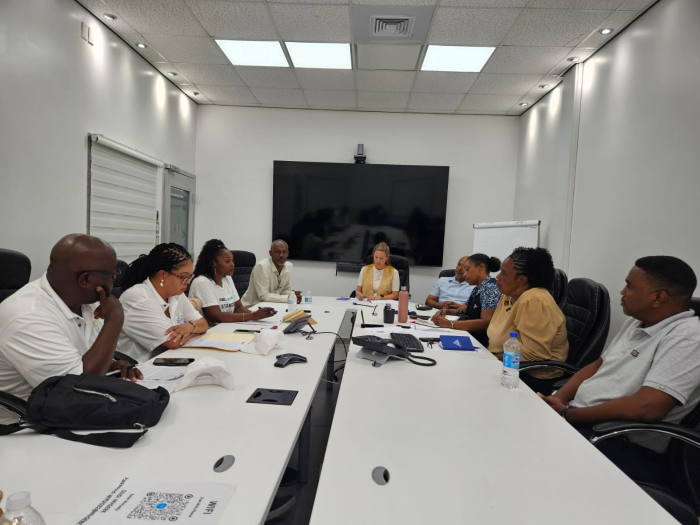 PHILIPSBURG:--- After a fruitful meeting with representatives of ACP-SXM on Friday, June 26, 2026, NV GEBE has decided to pause the disconnection of non-paying consumers, scheduled for this Monday, June 29, 2026.
 PHILIPSBURG:--- The National Employment Services Center (NESC), a Department within the Ministry of Public Health, Social Development and Labor (VSA), has
 PHILIPSBURG:--- On July 1st, 2026, in commemoration of the 163rd Anniversary of the Abolition of Slavery, the Government of Sint Maarten will present the official Emancipation Day ceremony at the Belvedere Plantation on the Oyster Pond Road. The official ceremony will begin at 8:00 am and end at 10:00 am. The program will feature official addresses, poetry, cultural song and dance performances, information tours, and a historical presentation on the Belvedere Plantation.
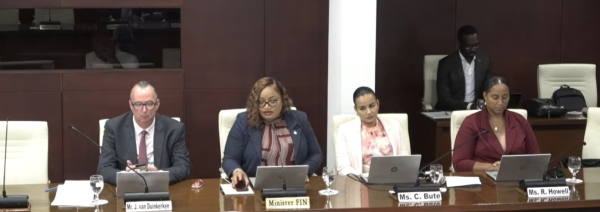 PHILIPSBURG:--- While Parliament has only just begun debating the 2026 National Budget, Minister of Finance Marinka Gumbs has already turned the government's attention to 2027, telling Members of Parliament that work on next year's budget is well underway in an effort to finally end years of chronic delays.