Vinaora Nivo Slider 3.xVinaora Nivo Slider 3.x

October 2 Deadline set for payment of 2025 income tax without penalty.


MARIGOT: --- The Collectivité of Saint-Martin and the Centre des Finances Publiques are informing taxpayers that income-tax notices covering revenue earned during 2025 are currently being distributed.

Taxpayers have until October 2, 2026, to pay their 2025 income tax without incurring an additional charge.

Anyone who has not received an assessment notice by September 15, 2026, must request a duplicate exclusively by email from the Centre des Finances Publiques of Saint-Martin. A copy of an identification document must be attached to the request.

Requests should be sent to:

This email address is being protected from spambots. You need JavaScript enabled to view it.

The subject line must state: “Demande de duplicata d’avis impôt sur le revenu + ISMIR tax number + surname and first name.”

The income-tax assessment is prepared using the taxpayer’s income declaration. It provides official confirmation of the income declared to the tax authorities.

The notice includes:

  • The income declared;
  • The number of family-quotient shares;
  • The reference taxable income;
  • The person’s tax status as a tax resident, equivalent resident, or non-resident;
  • The tax collection date of August 18, 2026;
  • The payment deadline of October 2, 2026;
  • The amount of tax calculated; and
  • Any remaining balance due or refund after accounting for previously paid provisional installments.

Taxpayers are strongly advised to keep their assessment notices because they are often required when conducting business with public and private institutions, including social-service agencies, family-allowance offices, the Préfecture, banks, and notaries. Provide a copy whenever proof of income or tax status is requested.

When an assessment notice shows an outstanding balance, bank transfer is the preferred payment method. The Treasury’s banking information appears on the assessment notice.

To ensure that the payment is correctly identified, the bank-transfer description must include the taxpayer’s ISMIR tax number, “IR 2026,” surname and first name.

The Collectivité reminded residents that income tax helps finance local public policies and contributes directly to the development of Saint-Martin. Taxpayers are therefore urged to meet the October 2 deadline.


Minister Heyliger-Marten Welcomes Donation of Fish Aggregating Devices (FADS) from Curaçao to Strengthen Local Fisheries.

grishafads10092026PHILIPSBURG:---  Minister of Tourism, Economic Affairs, Transport and Telecommunication (TEATT), the Honorable Grisha Heyliger-Marten, has welcomed the arrival of three Fish Aggregating Devices (FADs) donated to the Government of Sint Maarten by the Government of Curaçao, under the leadership of Prime Minister Gilmar Pisas.
The donation follows a work travel visit in 2025 by Minister Heyliger-Marten and represents an important step in the Ministry’s efforts to strengthen Sint Maarten’s local fisheries sector, expand opportunities for local fishers and support the country’s long-term food security.
“This donation demonstrates what meaningful cooperation within the Kingdom can deliver for our people,” Minister Heyliger-Marten stated. “I extend my sincere appreciation to Prime Minister Pisas and the Government of Curaçao for responding positively to our request and
supporting our efforts to create more opportunities for Sint Maarten’s fishers. This is a practical investment in an important local sector and in our ability to increase access to locally caught fish.”

FADs stand for Fish Aggregating Devices. FADs are floating structures placed in open water to encourage pelagic fish to gather in a particular area. Fish naturally associate with floating objects for shelter, shade, orientation, and access to food. Over time, algae and other marine organisms develop around the submerged sections of the device, attracting smaller fish and, in turn, larger species such as mahi-mahi, tuna, wahoo, yellowfin, and
blackfin tuna, and amberjack.
FADs do not create or significantly increase fish populations. Instead, they concentrate fish already present in the surrounding waters, making them easier for fishers to locate. When properly deployed and managed, they can help reduce the time and fuel required to search for fishing grounds while creating more targeted offshore fishing opportunities.
The donated FADs were constructed in Curaçao and are equipped with lighting, radar reflectors, and Automatic Identification System(AIS) tracking equipment to promote maritime safety. The Bureau Telecommunications and Post Sint Maarten (BTP) has approved and issued the Maritime Mobile Service Identity (MMSP) numbers required for the
devices. These unique identification numbers allow the FADs’ AIS beacons to transmit their identity and position to vessels and maritime authorities.

After consultations between the Nature Foundation Sint Maarten and local fishers, the Nature Foundation submitted proposed device locations, which BTP approved. Two FADs are expected to be deployed at the approved locations, while the third will be retained
in storage as a replacement or backup device.
A technical team from Curaçao will travel to Sint Maarten to assist the local team with the installation. Deployment will take place as soon as operationally feasible, taking into consideration the availability of the technical teams, suitable marine conditions, and the peak of the hurricane season.
The donation also includes a maintenance plan to guide the continued monitoring and upkeep of the devices following deployment.

“This initiative is about more than putting equipment in the water,” Minister Heyliger-Marten added. “It is about giving our fishers improved access to offshore fishing opportunities, supporting local livelihoods and taking another concrete step towards a stronger and more
productive fisheries sector. Our waters are an economic resource, and we must manage them responsibly so they can continue to provide opportunities for generations to come.”
The Ministry would also like to thank the Department of ETT, Mr. Shervin Frederick and his team, the Department of Shipping & Maritime, Nature Foundation and especially the fishermen (all others) that have played a role and will continue to do so once installation is complete. The Ministry of TEATT will continue working with the relevant authorities, technical partners, both internally and externally, and the local fishing community to
facilitate the safe deployment, management and maintenance of the FADs.

MP Ottley: 2027 Budget on time, but does it include GEBE relief.

omarottley10092026PHILIPSBURG: Following a recent interview with Chair of Parliament Sarah Wescot-Williams, Member of Parliament Omar E.C. Ottley said it was disheartening to hear concerns he has raised repeatedly over the past two years only now receiving renewed attention.

Ottley remains deeply concerned about what he described as the slow pace at which the government and governing coalition are taking action.

“The people cannot afford to keep waiting when decisions need to be made,” Ottley stated.

With Parliament having received the draft 2027 budget, Ottley said he hopes it includes some form of relief for consumers burdened by high GEBE bills. However, he questioned how such relief could be included when the government continues to say it is awaiting another report from the Bureau of Telecommunications and Post (BTP), even though the first BTP report was issued in April 2025.

More than 18 months after the initial RAC-BTP report, the people of Sint Maarten are still waiting for action.

Ottley questioned what the government intends to do if the new information BTP received confirms concerns about GEBE’s electricity tariffs and costs. He again called on the government to regulate through a ministerial regulation using the Price Ordinance, particularly in the absence of an LBHAM.

“If the new information confirms what has been argued all along, the government can no longer hide behind the excuse that the matter is still being studied,” Ottley said.

For the past two years, Ottley has warned that electricity costs are placing an unacceptable burden on households and businesses. He noted that, at one point, GEBE’s fuel clause increased while the price of oil per barrel was decreasing.

Ottley has repeatedly called on the government to use the regulatory tools already available. He said that if the government remains hesitant to adjust the electricity tariff through a ministerial regulation, it should use its authority to regulate the maximum prices charged for fuel imported for electricity production.

According to Ottley, the government appears proud of submitting the 2027 budget on time. However, he stressed that submitting a budget on time is not the same as submitting one that addresses the problems confronting the people of Sint Maarten.

“An on-time budget means very little if it contains no revenue-generating measures and does nothing to ease the burden on the people,” Ottley stated.

The MP said he has presented several motions, hosted town hall meetings, submitted a petition signed by members of the public and presented a draft ministerial regulation aimed at assisting the people of Sint Maarten. Despite those efforts, he said the government has taken no action, and the country is no closer to obtaining relief.

“The people have waited through reports. They have waited through consultations. They have waited for regulatory changes and promises of relief. Now they are being presented with the 2027 budget,” Ottley said. “If there is no meaningful allocation or concrete mechanism for GEBE relief in that budget, the government must explain why.”

Ottley said the irony is hard to ignore: the government appears eager to meet the budget submission deadline, while people continue waiting for it to meet its responsibility to provide effective regulation.

The MP is scheduled to meet with the government for a second time on September 15 to discuss the persistently high cost of living and the urgent need for meaningful relief for households and businesses.

Ottley’s previous meeting was held in November 2025 with the Minister of Tourism, Economic Affairs, Transport and Telecommunication. During that meeting, he presented a draft ministerial regulation based on the Price Ordinance that sought to establish maximum prices for water, electricity, heavy fuel oil, light fuel oil and lubricants.

This time, Ottley is expected to meet with Prime Minister Dr. Luc Mercelina. He intends to remind the government of the tools currently available and press for transparency on electricity and fuel prices within months—not another year and a half, as the government’s proposal to regulate through an LBHAM suggests.

During the upcoming meeting, Ottley said he will again highlight the Price Ordinance and the government’s authority to regulate maximum prices and profit margins where necessary.

“The people of Sint Maarten have heard enough about studies, frameworks and future intentions,” Ottley concluded. “They need to see and feel the difference in their monthly bills and daily cost of living.”

Territorial Council to debate supplementary budget, tax reform and major land acquisitions.

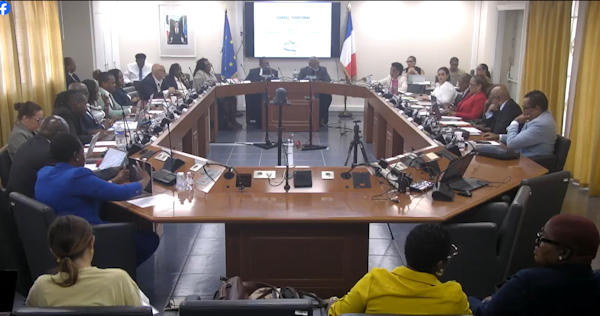
territorialcouncil10092026MARIGOT, Saint-Martin:--- The Territorial Council of Saint-Martin will meet in plenary session on Thursday, September 10, 2026, at 9:00 a.m. in the Council’s deliberation chamber to examine a wide-ranging agenda dominated by public finances, tax reform, land acquisitions and legal protection for four vice-presidents. 

Deliberation 12, concerning a partnership agreement between the Collectivité of Saint-Martin and SEMSAMAR on social-inclusion clauses in public procurement contracts, has been postponed.

Before considering the remaining deliberations, the Territorial Council will receive information concerning 11 prefectural orders issued in December 2025 and June 2026. The orders concern mandatory expenditures charged against the Collectivité’s budget under Article LO 6362-17 of the General Code of Territorial Collectivities.

The financial portion of the meeting will begin with the proposed allocation of the Collectivité’s 2025 financial result.

The Council will then examine the proposed write-off of irrecoverable debts and the corresponding reversal of provisions previously established against those debts. Members will also deliberate on provisions for doubtful receivables for the 2026 financial year.

Further debate is expected on the framework for program authorizations and the revision or adjustment of payment appropriations for 2026. The Council will also consider clearing expenses recorded under accounts 4817, 4818 and 486, including correcting accounting errors from previous financial years.

Another item concerns the Collectivité’s financial contribution to the 2026 budget of the Territorial Fire and Rescue Service, STIS 978.

Supplementary Budget and Tax Reform

One of the meeting’s most important items will be the vote on the Collectivité’s 2026 supplementary budget.

The supplementary budget allows the Collectivité to adjust its original 2026 budget based on updated revenue, expenditure, and financial information. Elected officials will be expected to examine whether the proposed adjustments adequately address the territory’s financial obligations and investment priorities.

The Council will also debate adopting a framework for tax reform and establishing an ad hoc commission to oversee and advance that process.

Sandy Ground Land Acquisition

Elected officials will be asked to authorize the Public Land Establishment Terres Caraïbes to acquire parcels AC 371 and BM 545 in Sandy Ground on behalf of the Collectivité.

The properties are intended for the development of public facilities, specifically parking and a cultural center for Sandy Ground.

The Council will also consider approving two related agreements between the Collectivité and Terres Caraïbes governing the acquisition and land-holding arrangement.

Beauperthuy Parcels Return to the Agenda

The proposed acquisition and holding of parcels from the Beauperthuy estates by Terres Caraïbes will also return to the Territorial Council for debate.

Under the proposed arrangement, Terres Caraïbes would acquire and temporarily hold the properties on behalf of the Collectivité of Saint-Martin.

The matter forms part of the Collectivité’s wider plan to secure strategic land for future public development. However, the arrangement is expected to generate questions about the financial obligations placed on the Collectivité, the length of the holding period and the specific plans for the properties.

CESC Expenses and SEMSAMAR Allowances

The Council will consider covering the travel, accommodation and meal expenses incurred by members of the Economic, Social and Cultural Council of Saint-Martin while performing their official duties.

Elected officials will also debate regularising allowances paid to representatives of the Collectivité who serve on SEMSAMAR’s Board of Directors.

That proposal also calls for the repeal of a June 14, 2023, deliberation that modified the May 30, 2022, decision authorizing representatives of the Collectivité on SEMSAMAR’s board to receive compensation for attending the company’s commissions and committees.

The proposed partnership agreement between the Collectivité and SEMSAMAR regarding social-inclusion clauses in public procurement, originally listed as Deliberation 12, will not be debated during Thursday’s meeting because it has been postponed.

Legal Protection for Four Vice-Presidents

The final four deliberations concern requests to grant functional protection to four vice-presidents of the Territorial Council:

  • Alain Richardson
  • Bernadette Davis
  • Dominique Démocrite Louisy
  • Michel Petit

Functional protection, under Article LO 6325-8 of the General Code of Territorial Collectivities, allows public officials to receive legal protection and assistance in matters connected to the performance of their official duties.

The agenda does not specify the legal matters for which the four vice-presidents are seeking protection.

The plenary session will conclude with oral questions from members of the Territorial Council.

2027 budget exposes financial threats at SZV, GEBE and TELEM—Hundreds of millions at stake.

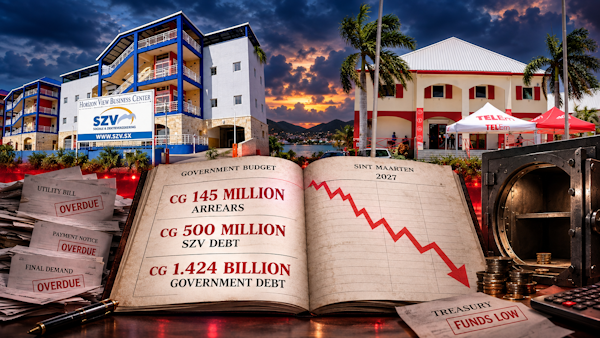
governmentdebts10092026PHILIPSBURG:---  St Maarten’s draft 2027 budget exposes serious financial risks involving SZV, utilities company N.V. GEBE and telecommunications company TelEm, while the government’s proposed relief for consumers remains largely dependent on future legislation, stronger price controls and possible tax reforms.

The most alarming figures concern the country’s healthcare and social-insurance system. According to the Committee for Financial Supervision (Cft), deficits at the ZV, OV and FZOG healthcare funds are projected at approximately Cg 35 million annually from 2027 through 2030.

SZV itself is expected to face additional operational deficits of approximately Cg 20 million per year over the same period.

Even after surpluses from other social funds—including the AOV pension fund—offset the shortfalls, SZV is still expected to record annual losses ranging from approximately Cg 15 million to Cg 25 million. The Cft warns that SZV’s liquid reserves could consequently be exhausted within several years.

Cg 500 million Interfund Debt

The Cft identifies a staggering accumulated debt of approximately Cg 500 million between the healthcare funds, SZV and other social funds.

The Country of Sint Maarten guarantees this amount, meaning that, in principle, the government could eventually be responsible for repayment.

The government is reportedly examining whether it could partially forgive the debt by using reserves from a proposed “fluctuation fund” that would form part of the General Health Insurance legislation. The Cft advised the government to obtain legal advice before moving in that direction.

The Cft also questions whether the current cross-financing between the different funds is lawful. Unless government produces an independent legal opinion establishing its legality, the Cft will consider the cross-financing unlawful and expects the deficits to be covered through legally permissible measures beginning in 2027.

Government owes SZV more than Cg 100 million

Separate from the Cg 500 million interfund debt, the government has accumulated an estimated debt of more than Cg 100 million directly to SZV, including arrears connected to the healthcare arrangement for civil servants, known as OZR.

The Cft said the government must establish a payment arrangement in the short term. Repayment would strengthen SZV’s liquidity and is also considered important for the Sint Maarten Medical Center, which depends on these payments.

The government has assigned SOAB to determine the precise amount of the arrears so it can negotiate a payment arrangement.

The 2027 budget separately includes:

  • Cg 38.5 million for the BZV healthcare contribution paid annually to SZV;
  • Cg 22 million for payments to SZV covering people who are uninsured or do not qualify for regular health insurance; and
  • Cg 5.5 million as the government’s annual contribution to SZV for civil servants and pensioners.

However, these scheduled payments do not resolve the enormous, accumulated debts or SZV’s projected structural deficits.

The Cft is pushing to implement General Health Insurance, a tourist tax, and an accompanying fluctuation fund by January 1, 2027. The government’s formal response states only that it is working on revenue-increasing initiatives, improved financial management, stronger oversight, and structural reforms.

GEBE’s finances remain hidden behind missing accounts

The budget describes GEBE's financial picture as “worrying.”

No financial statements or current financial information were available for 2023, 2024 or 2025. Government expects both GEBE’s liquidity position and equity to have deteriorated over the past two to three years.

The newest figures available are therefore from GEBE’s 2022 financial statements—the year of the cyberattacks. Those figures show:

  • Equity of Cg 226.6 million, compared to 204.1 million in 2021;
  • Net profit of Cg 23.8 million, compared to Cg 5.5 million in 2021;
  • Cash falling from Cg 54.6 million in 2021 to only Cg 1.5 million in 2022;
  • Receivables increasing from Cg 48.5 million to Cg 306.1 million; and
  • Short-term liabilities climbing from Cg 26.9 million to Cg 198.8 million.

The budget openly questioned how much of GEBE’s Cg 306.1 million in receivables it can actually collect. It also acknowledges that reliable valuation of the company’s assets and liabilities was affected by information lost during the 2022 cyberattacks.

In 2024, the government contracted a Cg 75.6 million loan on behalf of GEBE.

Despite this exposure, no current and audited information is provided to show Parliament whether GEBE’s financial position has improved or deteriorated since 2022. GEBE is said to be completing its 2023 financial statements, after which it intends to address 2024.

TelEm requested a Cg 5 million Government Guarantee

TelEm is projected to record a small profit of approximately Cg 500,000 for 2025, after suffering a Cg 7.6 million loss in 2024 and a massive Cg 38.4 million loss in 2023.

Nevertheless, the draft budget states that TelEm continues to experience difficulty meeting obligations to lenders and commitments arising from its restructuring programme. Its solvency ratio is described as weak.

TelEm requested a Cg 5 million government guarantee. The budget’s explanatory section says the guarantee had not yet been granted and that government was still investigating the possibilities and risks.

Government is also discussing the possible purchase of TelEm’s building—a transaction that could inject much-needed liquidity into the company.

However, a later response from Finance Minister Marinka Gumbs to the Cft appears to speak of the guarantee as an existing contingent liability. The minister said it would be called upon only if TelEm could not meet its financial obligations.

Government said there were currently no indications that TelEm would default and therefore included no provision for the guarantee in the budget. If the guarantee is eventually called, the financial consequences would be handled through a budget amendment submitted for approval.

The difference between the explanatory section—stating that the guarantee had not yet been granted—and the government’s later response requires clarification.

Cft Says Telem, GEBE and PSS face serious problems

The Cft concluded that TelEm, GEBE and Postal Services Sint Maarten are all experiencing serious financial problems.

The Cft identified TelEm and PSS as direct risks to public finances because they struggle to meet short-term payment obligations. The Cft recommended that government quantify these risks and include provisions or another appropriate financial solution in the 2027 budget.

Government’s formal response focused only on TelEm and PSS. It did not identify GEBE as one of the two entities that may have direct financial consequences for government—even though government borrowed Cg 75.6 million on GEBE’s behalf and the budget describes GEBE’s condition as worrying.

No financial support for PSS is presently included in the budget. Any future assistance would require approval from the Council of Ministers and would be introduced through a budget amendment.

Consumer Relief Remains mostly at the policy stage

The budget does not establish a broad, clearly funded electricity-relief or cost-of-living payout for residents.

Instead, the Ministry of TEATT proposes to provide economic relief through:

  • Modernization and enforcement of the Maximum Price System;
  • Price controls covering essential goods, food and fuel;
  • A public digital platform for monitoring maximum prices;
  • Stronger market inspections;
  • Consumer-awareness campaigns;
  • Proposed reductions in certain direct and indirect taxes; and
  • Measures intended to increase disposable income and consumer purchasing power.

The ministry says tax reductions could also allow businesses to invest, expand and create employment. However, the document largely describes these as policy objectives and proposed reforms, not as immediate financial relief already secured for households or businesses.

The 2027 budget therefore presents a sobering contradiction: government is promising stronger consumer protection and possible tax relief while simultaneously facing enormous healthcare liabilities, more than Cg 100 million in arrears to SZV, a Cg 500 million interfund debt, a Cg 75.6 million GEBE-related loan and possible further exposure through TelEm.

The figures are now before Parliament. The critical question is whether Parliament will demand binding solutions—or approve another budget in which the country’s most dangerous financial obligations are merely acknowledged and pushed into the future.



Subcategories

Vinaora Nivo Slider 3.x
Vinaora Nivo Slider 3.xVinaora Nivo Slider 3.x
Vinaora Nivo Slider 3.x